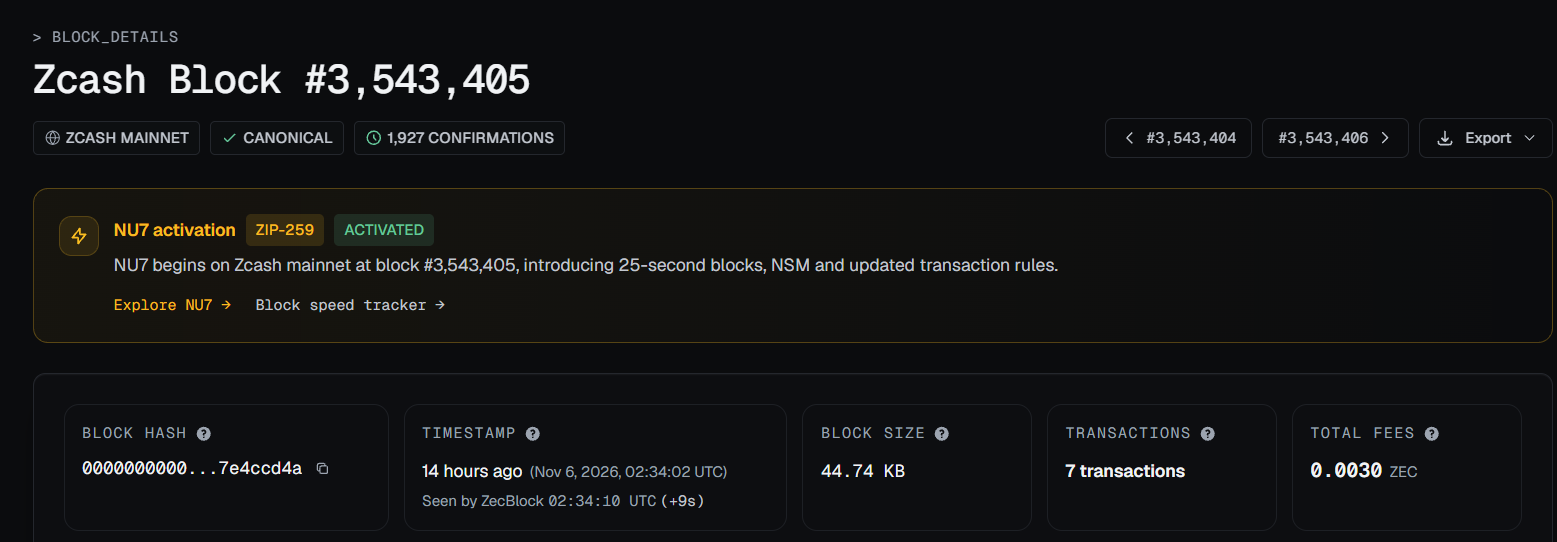
Zcash activates NU7 network upgrade, introducing faster transaction confirmations, increased private-payment capacity, and significant changes to the blockchain’s fee structure. The upgrade went live early Friday, November 6, reducing the target time between blocks from 75 seconds to just 25 seconds.
The activation took place at block 3,543,405 at approximately 02:34 UTC, marking an important development for the privacy-focused cryptocurrency. The changes are intended to make private transactions more practical for everyday payments, exchange deposits, and transfers between blockchain networks.
NU7 has successfully activated on mainnet. A new era of Zcash is here.
Under the new system, users could receive their first transaction confirmation approximately three times faster once block production stabilizes. Exchanges requiring three confirmations could potentially reduce waiting times from nearly four minutes to around 75 seconds.
NU7 Upgrade Introduces Faster Blocks and Greater Transaction Capacity
One of the most significant changes introduced by NU7 is the reduction in block intervals.
Zcash previously targeted one new block every 75 seconds. The new 25-second target allows the network to process blocks more frequently, potentially increasing its capacity to handle private payments. According to the upgrade specifications, the maximum throughput for simple Orchard shielded transactions could increase from approximately 2.9 to 6.6 transactions per second.
The upgrade also introduces limits on private transaction activity within individual blocks. These restrictions are designed to prevent excessive transaction activity from overwhelming wallets that need to scan the blockchain to identify incoming payments. The changes could reduce the worst-case daily download requirements for light wallets from 271 MB to approximately 169 MB.
However, the faster block schedule also creates technical challenges. Miners have less time to receive and validate competing blocks before another block is produced, potentially increasing the number of discarded blocks.
Testing conducted by developers showed a discarded-block rate of 3.43% under demanding conditions with 25-second intervals, compared with 1.57% under the previous schedule.
Zcash Changes Transaction Fees and Retires Original Privacy Pool
Beyond transaction speed, NU7 introduces an important change to Zcash’s economic model.
Under the new rules, miners receive 40% of transaction fees, while the remaining 60% is placed into a reserve intended to support future mining rewards.
The reserve mechanism is expected to begin distributing funds around February 2031, helping prepare the network for a future in which mining rewards become smaller. Another significant development involves Sprout, Zcash’s original privacy pool introduced in 2016.
NU7 disables legacy version 4 transactions, making approximately 12,224 ZEC remaining in Sprout unspendable. Developer Sean Bowe has discussed a possible recovery mechanism, although no solution had been approved at activation.
Zcash Technical Outlook After NU7 Activation
The upgrade represents a major network development, although its impact on ZEC’s market performance remains uncertain.
Investors will be watching whether improved transaction speeds and increased privacy capacity translate into stronger network activity and demand.
For now, the focus is on how successfully wallets, exchanges, miners, and node operators adapt to the new consensus rules.
Can NU7 help Zcash strengthen its position in the privacy-focused cryptocurrency sector?
Will faster private payments attract new users and institutional interest, or will the upgrade’s impact take longer to become visible in ZEC’s market performance?