




On Apr. 2, Coinbase received conditional approval from the Office of the Comptroller of the Currency for a national trust charter.
Coinbase joined a cluster of at least eight firms that the OCC has moved toward federal trust-charter status since December 2025, and the cluster reveals a deliberate federal decision about which parts of crypto belong inside the supervised system.
Why this matters: The US is shifting from regulating crypto to selecting which parts of the stack sit inside the banking perimeter. That decision defines who can scale nationally, who captures institutional flows, and who remains outside the system.
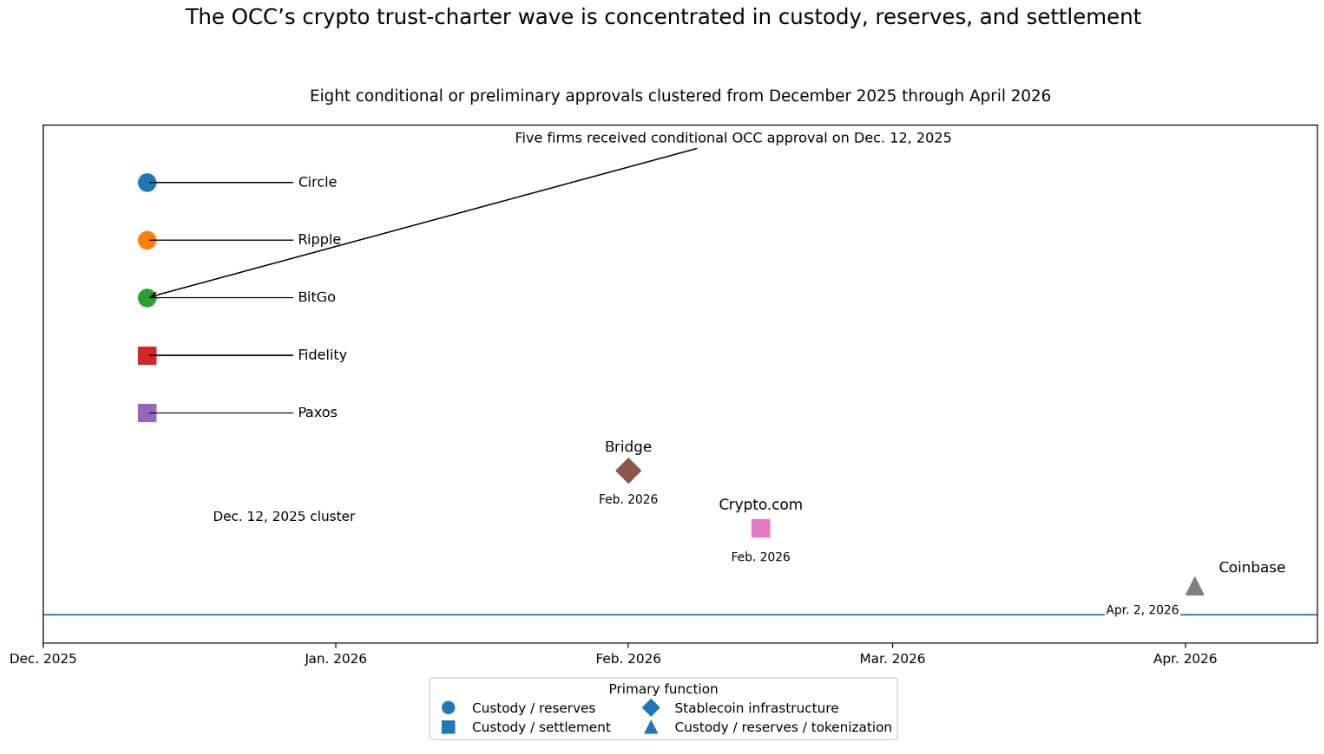
The OCC conditionally approved Circle, Ripple, BitGo, Fidelity, and Paxos on Dec. 12, 2025. Bridge followed in February, Crypto.com in February, and Coinbase in April.
Eight approvals in roughly four months, all clustered around custody, reserve management, stablecoin infrastructure, and settlement. That density reframes the Coinbase headline as a data point in a federal design decision.
A national trust charter gives firms federal reach under a single OCC supervisor, allowing them to operate across all 50 states without having to assemble a patchwork of state approvals.
National trust banks hold client assets and facilitate settlement under a fiduciary mandate, operating within a purpose-built custody-and-settlement structure. The lane’s practical value lies in scope and supervisory clarity: firms can hold client assets and handle settlement functions under a single federal framework.
Paxos explicitly framed its national trust push as a move beyond its New York state trust structure, and that framing reveals an architectural logic.
The functions Washington is comfortable supervising
The approvals cluster around custody, reserves, and settlement because that is where the OCC’s comfort level currently sits.
Reports noted that Crypto.com’s charter would cover client asset management and trade settlement, keeping the firm within custody and settlement functions. Bridge’s approval covered stablecoin issuance and orchestration, as well as reserve management.
The OCC’s Circle decision described digital-asset custody and reserve-management services tied to its fiduciary activities. Coinbase said full approval could support tokenized securities and stablecoins.
Washington is drawing a perimeter around the functions tokenized finance needs most, such as asset custody, stablecoin reserve backing, and settlement infrastructure, and extending supervisory authority over firms that provide them.
The firms best positioned in this environment are custodians, reserve managers, and stablecoin infrastructure operators.
Adjacent regulatory moves reinforce that reading. In March 2026, US bank regulators said tokenized securities would not face additional capital charges purely for being tokenized, calling the framework technology-neutral.
The SEC allowed intraday trading of tokenized shares of the WisdomTree money-market fund, approved Nasdaq’s tokenized trading proposal, and cleared NYSE’s tokenized securities partnership with Securitize.
The OCC charter wave and the tokenization rule stack are moving in tandem, with institutional infrastructure as the common thread.
VISUAL 2
The re-intermediation arc
Crypto’s original commercial promise was removing the regulated intermediaries that traditional finance required.
The practical outcome of the OCC cluster is re-intermediation: the most commercially durable crypto firms are now competing to become a new class of regulated intermediaries. Tokenized finance needs custodians, reserve managers, and settlement rails before it needs another trading venue with more listed assets.
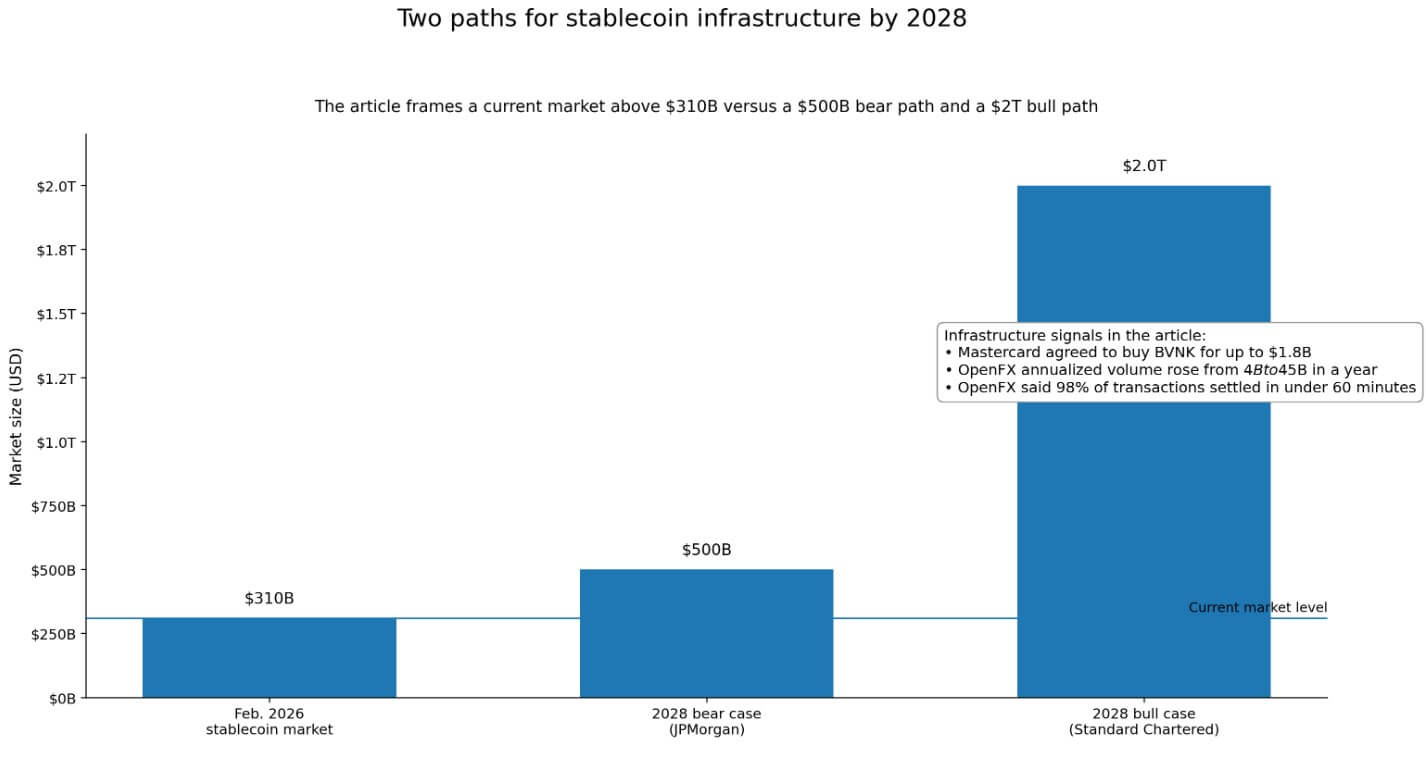
Capital is already pricing that reality. Mastercard agreed to buy BVNK, a stablecoin infrastructure firm, for up to $1.8 billion. OpenFX raised $94 million and reported annualized payment volume climbing from $4 billion to $45 billion in a year, with over 98% of transactions settling in under 60 minutes.
The global stablecoin market stood at over $310 billion in February 2026. These are backend-plumbing bets, concentrated in custody, settlement, and reserve management.
The competitive map is also narrowing. Anchorage is currently the only digital asset company operating under a full national trust bank charter. The December cluster and subsequent approvals are conditional or preliminary.
Getting to the final operating status requires demonstrating capital adequacy, governance, and operational controls to OCC examiners. This bar will compress the field toward well-capitalized incumbents with existing compliance infrastructure.
Two paths forward
In the bull case, the OCC finalizes its stablecoin implementation in terms that institutions can operationalize.
Tokenized securities pilots on Nasdaq and NYSE move from proof-of-concept to live settlement infrastructure, while firms like Mastercard accelerate the adoption of stablecoin rails across global payment corridors.
If stablecoins approach Standard Chartered’s $2 trillion forecast by 2028 and tokenized real-world assets reach comparable scale, federally supervised crypto utilities become the scarce picks-and-shovels of digital finance.
The OCC’s chartered custodians and reserve managers collect margin on trillions of dollars in assets that flow through the infrastructure they control.
In the bear case, final approvals move slowly as bank trade groups press their “lighter-touch charter” objection, and the OCC responds by tightening conditions on reserve buffers, liquidity stress tests, and operational controls.
The stablecoin market tracks closer to JPMorgan’s $500 billion by 2028 forecast, a ceiling anchored by the fact that payments account for only about 6% of current stablecoin demand, roughly $15 billion of the $310 billion outstanding.
In that world, state trust structures and bank partnerships stay practical, and the federal lane becomes a premium niche.
The federal bet
Washington is sorting crypto’s functions into those it wants to supervise and those it does not, or at least not yet.
The charter cluster, the stablecoin reserve rules under the GENIUS Act, and the technology-neutral treatment of tokenized securities together form a regulated stack for crypto-native financial infrastructure.
The power the OCC is extending is real. Still, it carries supervisory costs: monthly public reserve disclosures for stablecoin issuers, weekly confidential reporting under the proposed implementation rule, and full OCC examination authority.
| Comparison point | OCC national trust charter | State trust / state-licensed structure | Bank-partnership model |
|---|---|---|---|
| Primary supervisor | OCC | State regulators | Partner bank’s federal/state bank supervisor plus partner compliance requirements |
| Geographic reach | National, under a single federal framework across all 50 states | More limited; state-based and potentially patchwork | Depends on partner bank structure rather than firm’s own charter |
| Core functions highlighted in article | Custody, reserve management, stablecoin infrastructure, settlement, potential support for tokenized securities | Similar functions can be done, but without the same single federal lane | Practical way to access banking, payments, and settlement functions without own federal charter |
| Strategic value | Supervisory clarity and national scale | Flexibility, but less unified than federal lane | Faster/practical access for firms that do not want or cannot obtain a charter |
| Supervisory burden | High | Lower than OCC lane, based on article’s contrast | Shared/mediated through bank partner requirements |
| Stablecoin disclosure burden | Monthly public reserve disclosures; weekly confidential reporting under proposed implementation rule | Not described in article at the same level | Not described in article at the same level |
| Examination authority | Full OCC examination authority | State examination authority | Bank partner oversight and exam environment, not direct OCC trust-bank status for the crypto firm |
| Firms best positioned | Well-capitalized incumbents with strong governance, capital adequacy, and operational controls | Firms comfortable staying in state-licensed layer | Firms using partnerships as a practical alternative to federal chartering |
| Competitive implication | Could become scarce “picks-and-shovels” infrastructure if tokenized finance scales | Remains viable if federal approvals stay slow or narrow | Remains viable in bear/slower-adoption scenario |
| Main tradeoff | National reach and legitimacy, but heavier compliance and supervisory costs | Less supervisory intensity, but less federal uniformity | Less direct control over infrastructure stack, but easier access route |
| Best fit in article’s framing | Firms aiming to be federally supervised crypto utilities | Firms that stay outside the federal lane | Firms choosing a practical alternative while the federal lane remains selective |
The firms that clear that bar will operate nationally under a single federal supervisor, hold institutional assets, and process tokenized settlements in a framework that traditional finance counterparties can use.
Those who cannot or choose not to will stay in the state-licensed layer, and the charter wave is starting to sort itself out.
The post Washington has started selecting which crypto firms control custody at a national level appeared first on CryptoSlate.


