




The post Bittensor Sees Institutional Push: Is TAO Entering Its Next Phase? appeared first on Coinpedia Fintech News
Bittensor may be entering one of its most important phases, yet the market is barely paying attention. While TAO continues to trade nearly 60% below its peak, a combination of institutional infrastructure, tightening supply, and shifting market structure is beginning to reshape its positioning. Price is no longer falling, sentiment remains muted, and capital is starting to move quietly beneath the surface.
The real question now isn’t why TAO price is down, it’s whether this quiet phase is where the next expansion is being built.
Institutional Access Expands With BitGo Integration
The latest shift comes from BitGo’s partnership with Yuma, introducing institutional-grade access to Bittensor subnet tokens. This allows clients to stake and trade subnet assets through a secure, unified platform, removing a major barrier for institutional capital.
The significance lies in timing. Infrastructure is being built while TAO remains deeply discounted, suggesting early positioning rather than reactive participation. Historically, this sequence, where access improves before price, has often preceded capital inflows. At the same time, Bittensor’s subnet ecosystem continues to expand, approaching $1.5 billion in cumulative value. This steady growth highlights that network activity is progressing independently of price volatility.
TAO Price Holds Discount Zone as Structure Begins to Shift
TAO’s current structure reflects a transition rather than continued decline. After peaking near $767, the asset is now trading around $240–$250, holding firmly within the $236–$258 demand zone. This level has consistently absorbed selling pressure, indicating that downside momentum is weakening. Instead of trending lower, token price is stabilizing, suggesting that accumulation is gradually replacing distribution.
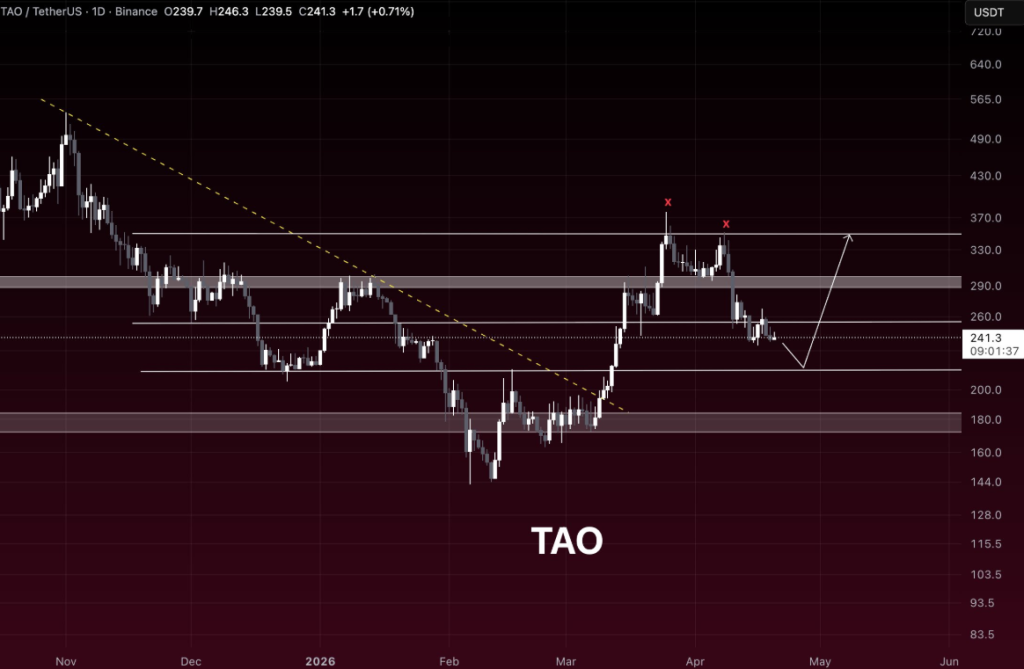
Momentum indicators support this shift. The Stochastic RSI remains in oversold territory, historically associated with accumulation phases. At the same time, moving averages are compressing, signaling reduced volatility and the potential for a directional move ahead. This is typically the phase where early capital positions, long before momentum becomes obvious.
However, confirmation remains critical. The $320–$383 range acts as the structural pivot. A breakout above this zone would signal a shift in market control and open the path toward higher levels.
Derivatives Data Signals Positioning Reset
Derivative metrics reinforce the same narrative. Funding rates remain low, reflecting the absence of aggressive long positioning, while open interest has stabilized after prior volatility.
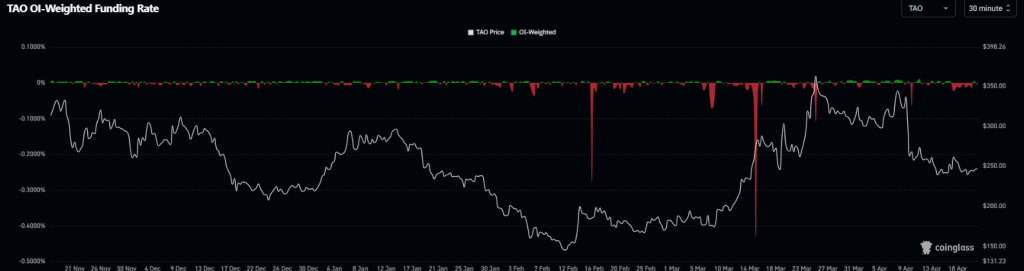
This indicates that leverage has reset and speculative pressure has eased. Rather than chasing momentum, market participants appear to be rebuilding positions gradually. Such conditions often emerge during early-cycle phases, where positioning occurs quietly before broader participation returns.
Bittensor’s Fundamentals Strengthen the Narrative
Bittensor’s fundamental backdrop is evolving alongside its market structure. The first TAO halving has reduced block rewards by 50%, tightening supply dynamics at a time when price is already in a discount zone. The introduction of Dynamic TAO (dTAO) adds another layer of utility, enabling subnet-specific tokens and integrated liquidity mechanisms. This expands the network’s functionality and strengthens long-term demand drivers.
Institutional signals are also emerging. Exposure within AI-focused funds is increasing, while discussions around a potential ETF later in 2026 add a forward-looking catalyst. Notably, nearly 70% of TAO supply remains staked despite the drawdown, reflecting strong holder conviction and reinforcing the ongoing accumulation phase.
Outlook
TAO is not yet in a confirmed uptrend, but the conditions around it have clearly shifted. TAO price has stabilized, leverage has reset, and institutional infrastructure is expanding at a time when sentiment remains subdued. If TAO reclaims the $320–$383 zone, the structure transitions from accumulation to expansion. Until then, the current phase remains critical, where positioning builds quietly before the market begins to react.