


Michael Arrington, founder of Arrington Capital, said the XRP ecosystem could have “no upper limit” in value if Ripple stays focused on its mission and keeps executing, framing the company’s infrastructure buildout as a long-duration bet on institutional crypto rails rather than a short-term market narrative.
Speaking on Ripple’s Onchain Economy series in an episode published April 20, Arrington argued that Ripple and XRP have been “completely misunderstood” over the past decade, and said the company’s recent push across stablecoins, prime brokerage, acquisitions and product development could help pull more startups and institutional participants into the ecosystem.
Why XRP Is Becoming Crypto’s Infrastructure Standard
Arrington tied that view directly to what he sees as Ripple’s growing role as an infrastructure provider. “A lot of the things that Ripple is doing around XRP, particularly the stablecoin, I think makes it inevitable that we’re going to see an increasing number of these startups focusing on building on that ecosystem as well,” he said. “I think we’ll be there to invest in that evolution.”
That framing matters because Arrington was not pitching token primarily as a speculative asset. Instead, he described Ripple’s strategy as an attempt to build foundational market structure for crypto firms and institutions that still lack the tooling available in traditional finance. He said hedge funds operating in digital assets need more robust infrastructure, “not just for compliance,” but for basic market function, custody and execution.
Arrington also pointed to Ripple’s acquisition of Hidden Road, which he referred to as being rebranded as Ripple Prime, as a concrete example of that thesis. “It’s just a prime broker at its essentially. Seems so simple and prime brokers are a dime a dozen in the real world, but in crypto, we’ve never found one that’s very good,” he said. “So it’s going to be a huge business and like a backbone of what Ripple and XRP become. And we need that infrastructure like super badly.”
The remarks fit with a broader point Arrington made throughout the interview: that Ripple’s differentiation was visible early, even in the more chaotic phases of crypto’s first major venture cycle. Looking back on 2017, he recalled an ICO market flooded with projects, many of which later failed despite the burst of activity. He said that period helped push him from a traditional Silicon Valley venture fund into crypto full time, and added that he first bought XRP in 2017 when it was trading in the 3-cent to 5-cent range.
History will tell the story of XRP and Ripple as a fundamental part of our ecosystem.”
Great insight from Michael Arrington on why the institutional focus and mission-driven approach of Ripple matters more than ever.
It’s about building the infrastructure for the future. pic.twitter.com/M2zgkQv3Ry— 𝗕𝗮𝗻𝗸XRP (@BankXRP) April 20, 2026
He also argued that the public image lagged behind what Ripple was actually building. “Ripple and XRP have been completely misunderstood in the last decade,” Arrington said. “Skeptics of XRP would call it either corporate coin, the banking coin, and I think history will tell a story about XRP and Ripple that’s it’s a fundamental part of our ecosystem.”
For Arrington, that misreading has obscured what he described as a mission-driven company that has stayed unusually consistent over time. “If Ripple, which is very mission-focused, has shown that over at least the last decade, can continue to hyperfocus on what their mission is and then execute on that, there is no upper limit on the value of that ecosystem in general,” he said.
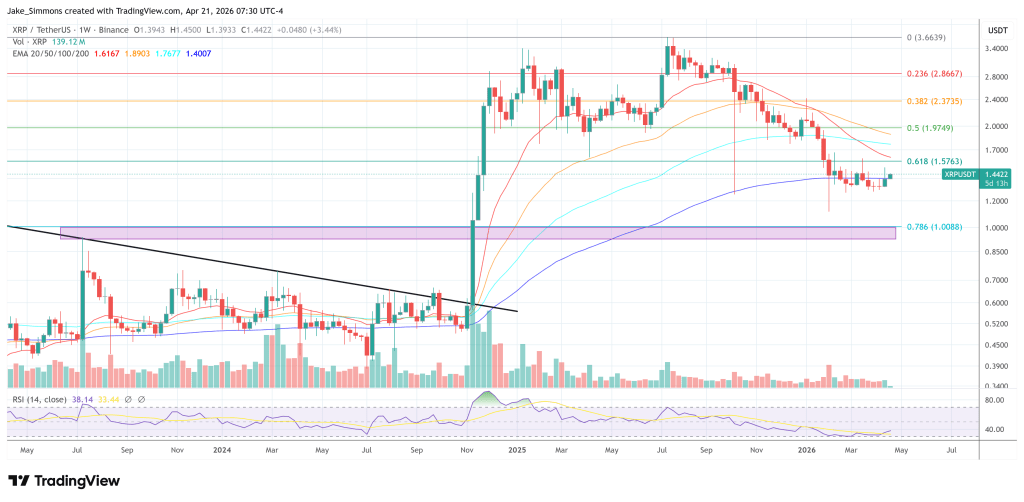
At press time, XRP traded at $1.44.