





The stablecoin market has long rewarded the companies that issue digital dollars. They take in customer cash, hold reserves in short-term government securities, and earn the yield.
Now, the companies that distribute those tokens want more of the economics.
That tension is at the center of Open USD (OUSD), a planned stablecoin backed by more than 140 financial, technology, and crypto firms, including Coinbase, Visa, Mastercard, Stripe, BlackRock, and Google.
The project promises free minting and redemption for businesses, as well as a reserve-income model that sends more value to the platforms driving adoption.
For Circle, the USD Coin (USDC) stablecoin issuer, the most important name on that list is Coinbase.
The exchange helped turn USDC into one of crypto’s most widely used dollar tokens. Coinbase said in its first-quarter report that more than 25% of USDC in circulation, or about $19 billion on average, was held across its products. It also said Base, its layer-2 network, processed 62% of global on-chain stablecoin transaction volume during the quarter.
That makes Coinbase’s support for OUSD more than a symbolic endorsement. It gives Circle’s most important distribution partner a stake in a rival model just as the economics of stablecoin issuance are becoming more contested.
The cost of distribution
OUSD’s consortium launch represents a direct challenge to the incumbent stablecoin sector, which currently commands a market capitalization exceeding $320 billion.
For years, pure-play issuers like Circle and Tether have operated high-margin models by retaining the interest income generated from the billions of dollars backing their tokens.
However, as stablecoins migrate from speculative trading assets to foundational rails for global settlement and payments, the companies providing the actual customer pipelines are demanding a fundamental realignment of the revenue-sharing architecture.
OUSD addresses this by aiming to eliminate standard minting or redemption fees and to structurally return most of the reserve yield directly to its distribution partners.
The immediate market impact was palpable, with Circle’s shares falling 16% on the day the consortium was announced. The drop underscores investor anxiety regarding the durability of Circle’s core commercial relationship with Coinbase.
That relationship has historically been highly lucrative but increasingly complex. In 2024, Circle paid Coinbase $908 million under their revenue-sharing agreement, reflecting the exchange’s role as one of USDC’s most important distribution and liquidity channels.
Public financial disclosures show that Coinbase captured a larger share of the USDC revenue pool than many investors expected, highlighting the premium placed on distribution over raw issuance.
For the full year 2025, Coinbase’s stablecoin-tied revenue totaled approximately $1.35 billion, accounting for roughly 19% of its total annual revenue.
So, Coinbase’s pivot toward a founding role in OUSD gives it a powerful alternative asset exactly when its current contract with Circle approaches a critical milestone. The distribution agreement between the two firms operates on a three-year cycle, with the next expiration date set for August 2026.
Tiger Research stated that stepping to the negotiating table as a central architect of a competing, distributor-first stablecoin provides Coinbase with substantial commercial leverage.
Coinbase CEO Brian Armstrong kept public comments brief, stating only that the firm is “excited to advance the adoption of stablecoins” and update the global financial system.
However, the underlying mechanics suggest a broader industry realization: the entities that control the distribution network are no longer willing to leave the bulk of reserve interest income on the table.
Circle Defends the Incumbent Model
Circle is pushing back against the narrative that distribution can easily replicate built-in network infrastructure.
In an X post, Circle CEO Jeremy Allaire mounted a detailed defense of the USDC network, arguing that stablecoins operate as platform and network-effect businesses that tend toward “winner-take-most” structures over extended horizons.
Allaire, citing Artemis data, stated that USDC handled nearly $30 trillion in on-chain transaction volume during the first quarter of 2026, accounting for 80% of all dollar-denominated stablecoin transactions across major blockchains.
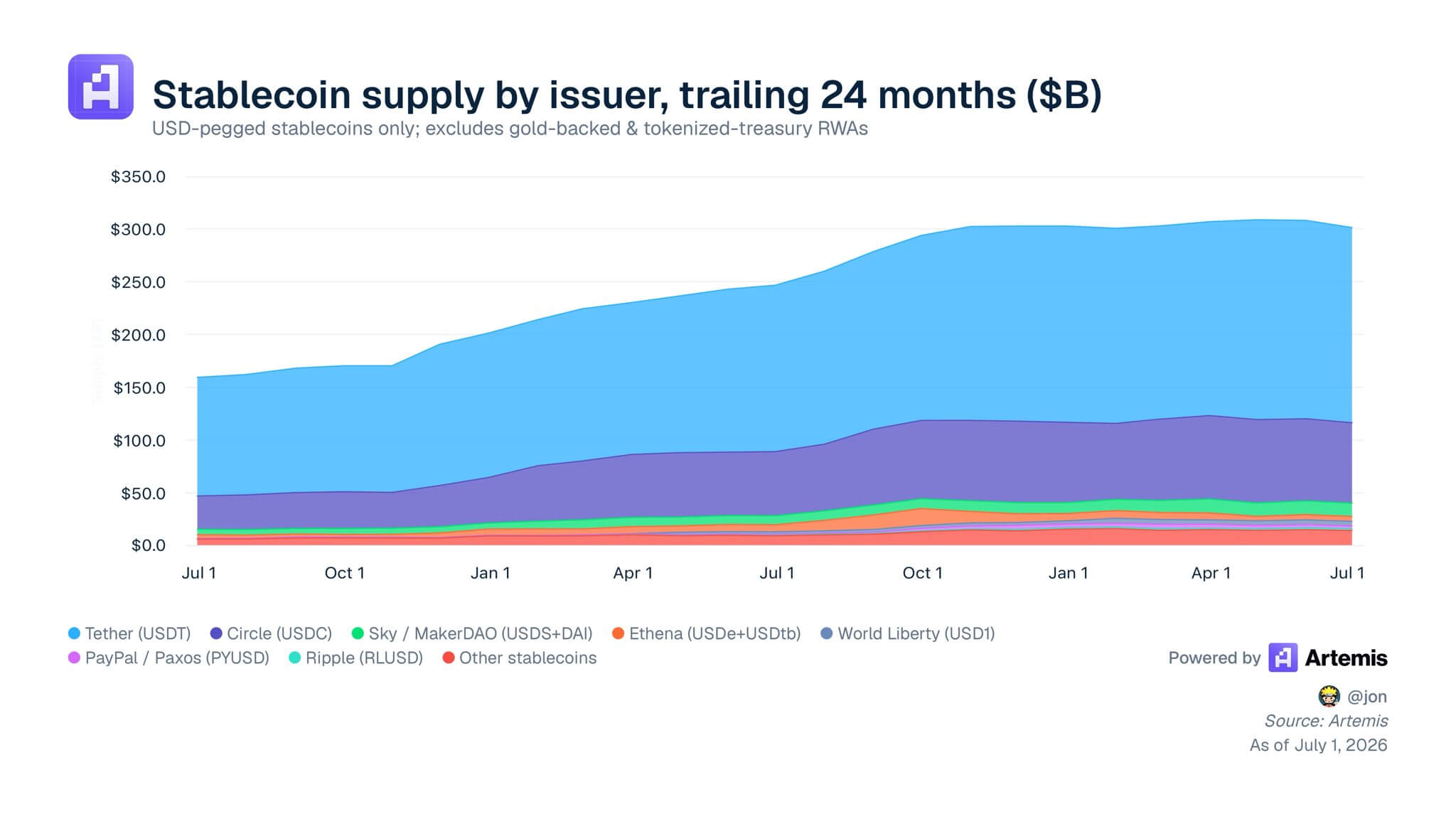
He noted:
Today, USDC is in the top 3 most liquid digital assets in the world, and it falls off sharply after that. BTC, USDT and USDC have extraordinary liquidity. The closest other dollar stables are like 10x smaller and that liquidity tends to be concentrated in promotional books in a single exchange, whereas USDC liquidity is dispersed widely across dozens and dozens of surfaces. Building this liquidity has been a nearly decade-long task that we continue.
Allaire maintained that these metrics reflect nearly a decade of deep integration that cannot be instantly substituted by a corporate coalition. He emphasized that USDC’s presence across major financial market centers, decentralized finance (DeFi) protocols, and global payment service providers creates an operational moat.
Addressing OUSD’s fee structure, Allaire noted that while zero-fee models sound appealing in marketing materials, market realities often require more structured commercial approaches.
He indicated that Circle already mitigates transaction friction through bespoke contractual agreements with its enterprise payment partners rather than relying on blanket fee exemptions.
Furthermore, Allaire questioned the operational viability of large-scale corporate alliances in the fast-moving digital asset space, describing the historical performance of financial consortia as “predictably slow-moving.”
He remarked:
“Large groups of large companies coordinate poorly, have misaligned incentives, slow things down and rarely create the space for real durable innovation and competitiveness.”
He revealed that Circle experimented with a restricted consortium structure during USDC’s early years but found that smaller, autonomous strategic collaborations consistently outpaced committee-driven networks.
From an operational standpoint, Allaire warned that giving away all reserve income leaves a stablecoin network without the retained capital needed to fund global licensing, compliance, and 24/7 treasury management infrastructure.
OUSD faces obstacles to scale
Market analysts also express caution regarding how effectively OUSD can translate its impressive list of corporate logos into active on-chain liquidity.
Lorenzo Valente, Director of Research for Digital Assets at ARK Invest, noted that any new stablecoin faces a severe “cold-start” dilemma. Capital markets and crypto exchanges are heavily optimized around entrenched trading pairs denominated in USDT and USDC.
He wrote:
“A consortium of 500 rivals has no precedent for working. Circle and Tether ship whatever they want, whenever they want, with zero commitment to anyone. The pace of decision-making across competitors is going to be glacial.”
Valente also raised concerns about regulatory and antitrust scrutiny. While Circle and Tether have spent years accumulating multiple licenses and regulatory relationships worldwide to withstand global regulatory pressure, a unified issuance vehicle backed simultaneously by the world’s largest credit card networks, asset managers, and retail banks represents a high-profile target for antitrust regulators.
Meanwhile, the long-term alignment of OUSD’s founding members remains a variable.
Stripe recently acquired the stablecoin infrastructure firm Bridge and continues to develop its independent fintech suite. Major banking partners are testing proprietary tokenized deposit systems, while firms like Ripple are rolling out their own specialized stablecoins.
Because these massive distribution networks are actively hedging their strategies across multiple concurrent digital asset products, the lack of exclusive distribution commitments could dilute OUSD’s network velocity.
In view of this, Kayla Phillips, the blockchain VC at Hivemind, said:
“How will all these parties coordinate and govern? Seems unlikely that all 140 will have an equal seat at the table, if they want this to be effective. If not on the governing board, will they still be incentivized to participate in the consortium?”
The fragmentation of on-chain settlement
The emergence of OUSD highlights a broader trend toward the fragmentation and potential abstraction of the stablecoin layer.
Rather than operating as a standalone consumer-facing product, the technology is increasingly viewed by major corporations as a commoditized back-end settlement mechanism.
For Circle, maintaining its market share will require accelerating the deployment of its value-added developer stacks, such as its Cross-Chain Transfer Protocol (CCTP) and embedded institutional wallets, ensuring that its software layer provides utility that goes beyond basic interest margin distribution.
Ultimately, the competition over stablecoin supremacy has shifted from technical implementation to a direct negotiation over network economics.
As distribution platforms organize to retain more of the yield generated by their own user bases, the issuer-led model faces its strongest distribution-side challenge yet.
The post Coinbase helped build USDC – Why is it now backing the stablecoin trying to replace it, Open USD? appeared first on CryptoSlate.


