





Lincoln Murr asked his AI agent to send some Twitter articles to his Kindle, copying a trick he’d seen suggested online. The agent scraped the articles with Firecrawl once Twitter started blocking it, then uploaded the result to a service called Stable Upload so it could reach his email.
Murr, who leads AI product work at Coinbase, told CryptoSlate he’d genuinely forgotten the agent even had a crypto wallet.
Both Firecrawl and Stable Upload sit among the expanding list of services built around x402, an open payment standard that lets software pay for access to the moment it needs it.
His agent picked both providers, paid them in small increments, and finished the task without a single approval from him along the way.
When the agent picks the vendor
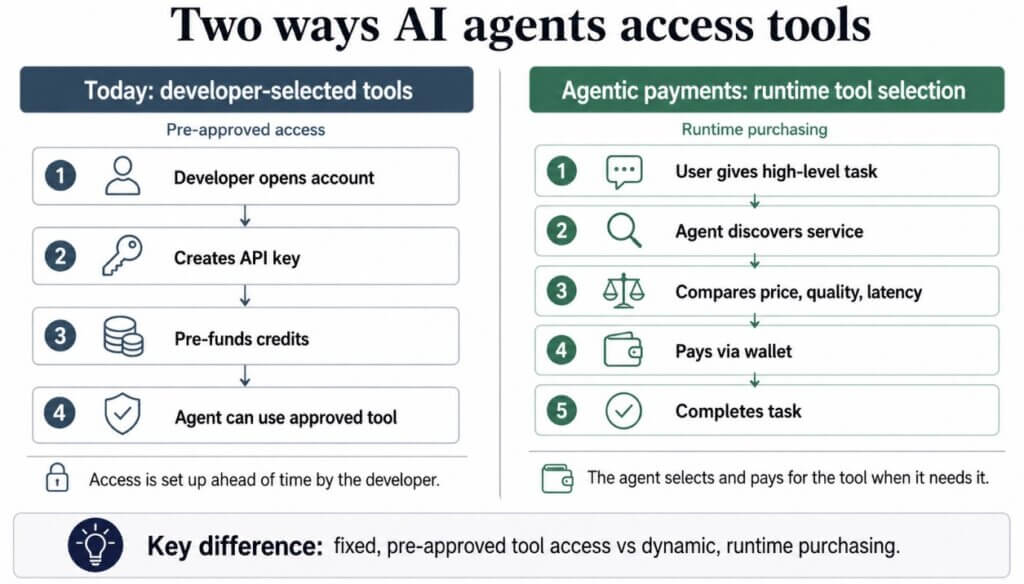
Most AI tools today work because a developer opened the account, generated the API key, and funded the credits.
Murr described a pattern taking hold in which an agent given a high-level task can shop for whatever capability it needs during the work itself.
He offered a cleaner example where a user asks an agent to turn a PDF into a podcast, and it can weigh Google’s NotebookLM against ElevenLabs on cost, quality, and response time, then pick whichever fits the task, sometimes catching a first-time-user discount along the way.
Murr noted that the wallet does double duty, serving as both the agent’s identifier and its payment method, a combination that replaces the whole ritual of signing up for API keys and pre-funding an account before an agent can touch a new service.
The Linux Foundation launched an x402 Foundation in April, with Coinbase contributing the original protocol alongside early backers including AWS, Stripe, Visa, Mastercard, American Express, Shopify, Google, Microsoft, and Cloudflare.
Coinbase’s Bazaar now indexes over 10,000 paid tools that an agent can search and call directly, functioning close to Murr’s description: a directory built with agents as the primary users.
AWS added a feature this June that lets CloudFront customers return a machine-readable price and payment terms to any bot requesting protected content, and then verify payment at the network edge before granting access.
Cloudflare launched its version in July, describing the new setup plainly: the agent becomes the buyer, and the request becomes the transaction.
From attention to utility
Murr framed the underlying move as a transition from an economy built on attention toward one built on utility.
He said that the internet runs a “Napster, Limewire” version of agent access, where an agent can scrape a site freely because there’s no real equivalent of an ad for software to notice.
Cloudflare and AWS together sit in front of roughly half of global internet traffic, giving them the position to alter that by charging agents a few cents for the privilege of reading a page at all.
Murr argued that the same transition could hollow out the subscription model from underneath, as a flat monthly fee primarily benefits the business that collects it. A world where a million agents each pay a cent per call opens up something closer to walk-in retail: frictionless, one-off, and open to anyone.
He expects microtransactions to work as a top-of-funnel, with agents graduating into steadier vendor relationships, discounts, and bulk pricing once a pattern of paid use builds trust on both sides.
Who controls the directory?
An economy where agents choose which services are paid raises the question of who ultimately decides what gets discovered and ranked.
Murr pointed to x402’s governance as the answer, a foundation built from companies like Stripe and Coinbase that would ordinarily be competitors.
Cloudflare will still control what happens on sites that sit behind its infrastructure, and the broader goal is folding payment into the internet’s plumbing itself, the way HTTP became a shared standard nobody owns.
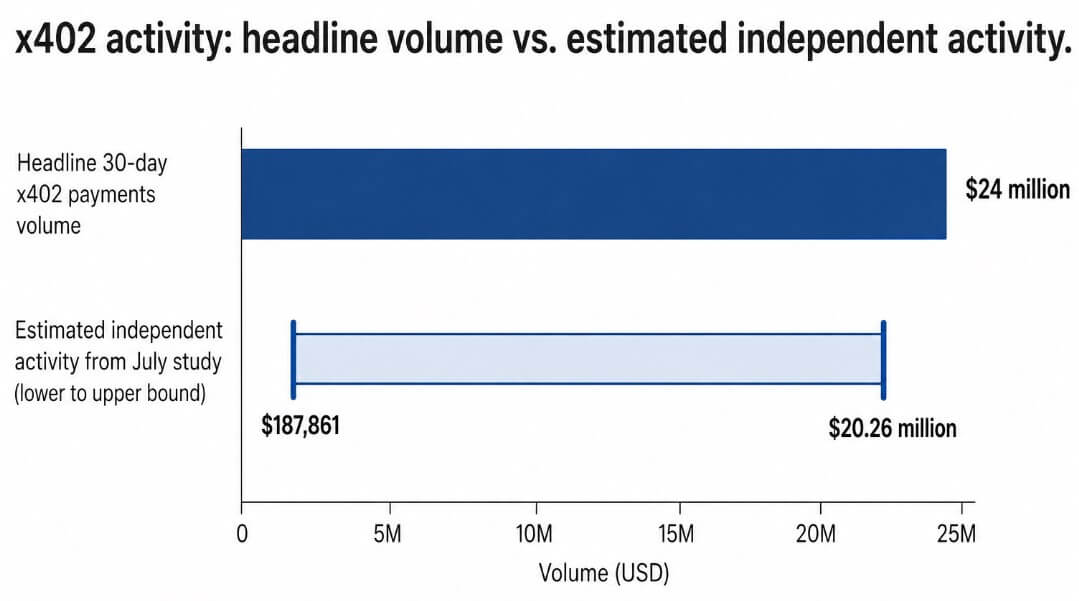
x402 processed roughly 75 million payments totaling $24 million over a recent 30-day period, averaging about $0.32 per transaction.
However, a population-scale study published in July complicates the picture, finding that a large share of on-chain x402 settlement activity was either fictitious or occurred within linked internal clusters.
Genuinely independent economic activity falls somewhere in between.
The study could verify just $187,861 as payments to identifiable independent services. Another $20.07 million could be genuine, but the researchers could not rule out undiscovered links between the wallets involved.
Murr said that Coinbase wants to become what he called the backbone of the agentic economy, holding the accounts, the settlement rails, and the discovery layer all at once, and he pointed out that not enough people currently carry wallets that make these small purchases routine.
The test ahead for agentic spending
Agentic trading is the place to watch this get tested, since a trading agent’s decisions produce a number you can grade directly against the cost of the data it bought.
Murr referenced a years-old idea from Ethereum’s Vitalik Buterin that AI agents would end up as the primary traders in low-liquidity prediction markets precisely because their research cost is so low that it isn’t worth a human’s time.
Coinbase is building a product to let agents trade and pay directly from a retail account, and Murr expects the resulting loop, agents paying for premium data, using it to trade better, and pulling more data providers onto the rails, to gain real traction within six months.
If agents get reliably good at judging whether the next purchase is worth it, budget-aware routing becomes a genuine edge: comparing free and paid search, cheap and expensive models, raw and verified data, and, as one recent paper on budget-constrained reasoning found, smarter allocation beats brute-force approaches using four times the resources.
The strongest AI product in that world manages a portfolio of paid inputs, going well beyond simply running the largest available model.
| Paid input | What the agent must estimate | When it is worth paying | Failure mode |
|---|---|---|---|
| Another search | Whether new sources are likely to change the answer | When confidence is low or the topic is fast-moving | Paying repeatedly for duplicate information |
| Premium data | Whether proprietary data improves the decision enough to justify cost | When the task has measurable financial or strategic value | Buying “premium” data that adds no edge |
| Stronger model | Whether better reasoning is needed for this step | When the task requires synthesis, judgment, or complex tradeoffs | Using expensive models for simple tasks |
| Verification | Whether checking the result reduces meaningful risk | When the cost of being wrong is high | Underinvesting in checks to save pennies |
| Specialist software | Whether a purpose-built tool beats general reasoning | When the task needs scraping, storage, formatting, trading, or execution | Choosing cheap but unreliable tools |
If wallets, trust, and reliable value estimates remain scarce, the paid-access infrastructure keeps outpacing use, with most transactions confined to demos, internal testing, and narrow developer workflows, as the July settlement study already shows.
Murr’s admission about weak demand becomes the more accurate read of where things stand: the rails exist well before the economy running on them does.
Every piece of that system, the wallet, the discovery layer, the settlement rail, exists to answer whether the next cent an agent spends will make its results better. Murr is chasing a real answer to that question alongside everyone else racing to build this economy, and right now that answer is still taking shape.
The post AI agents employ $24M market to act smarter as agentic crypto payments spread online appeared first on CryptoSlate.



