





Michael Saylor-led Strategy sold another $263.5 million of common stock last week, but the company used the fundraising to expand its cash reserve rather than add to its Bitcoin holdings.
According to a July 20 SEC filing, the Tysons Corner, Virginia-based company issued 2.73 million Class A shares between July 13 and July 19, while reporting no sales through any of its four preferred-stock offering programs.
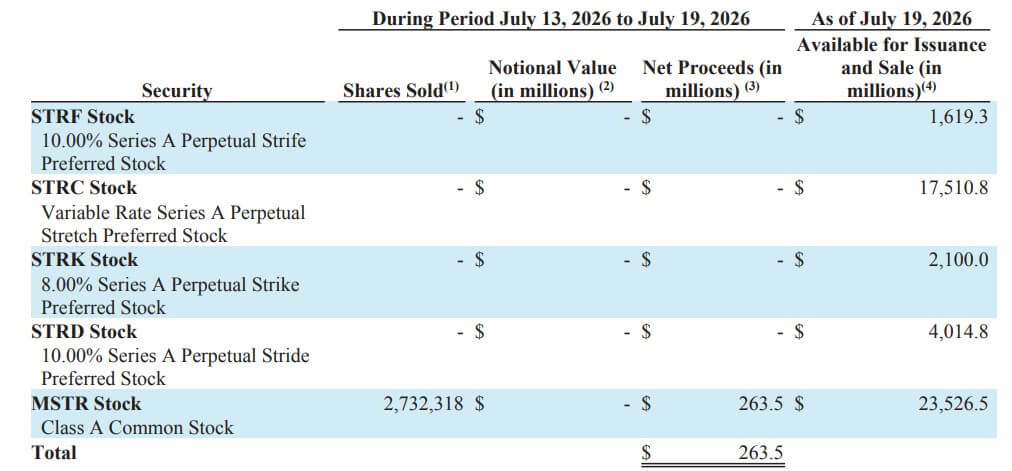
The transactions lifted Strategy’s designated US dollar reserve by $225 million to $3.225 billion.
Strategy purchased no Bitcoin during the period, extending its buying pause to four consecutive weeks and leaving its holdings unchanged at 843,775 BTC.
The shift has also pushed its quarter-to-date Bitcoin performance measures into negative territory, as the number of common shares has risen without a corresponding increase in the company’s crypto balance.
STRC’s discount puts cash coverage first
The reserve buildup reflects Strategy’s effort to strengthen a preferred-stock business carrying about $1.76 billion in expected annual dividends and interest expense.
At roughly $3.2 billion, the reserve would cover about 22 months of those payments, well above the 12-month minimum set under a policy approved by the company’s board in June. The fund stood near $3 billion before last week’s common-stock sale.
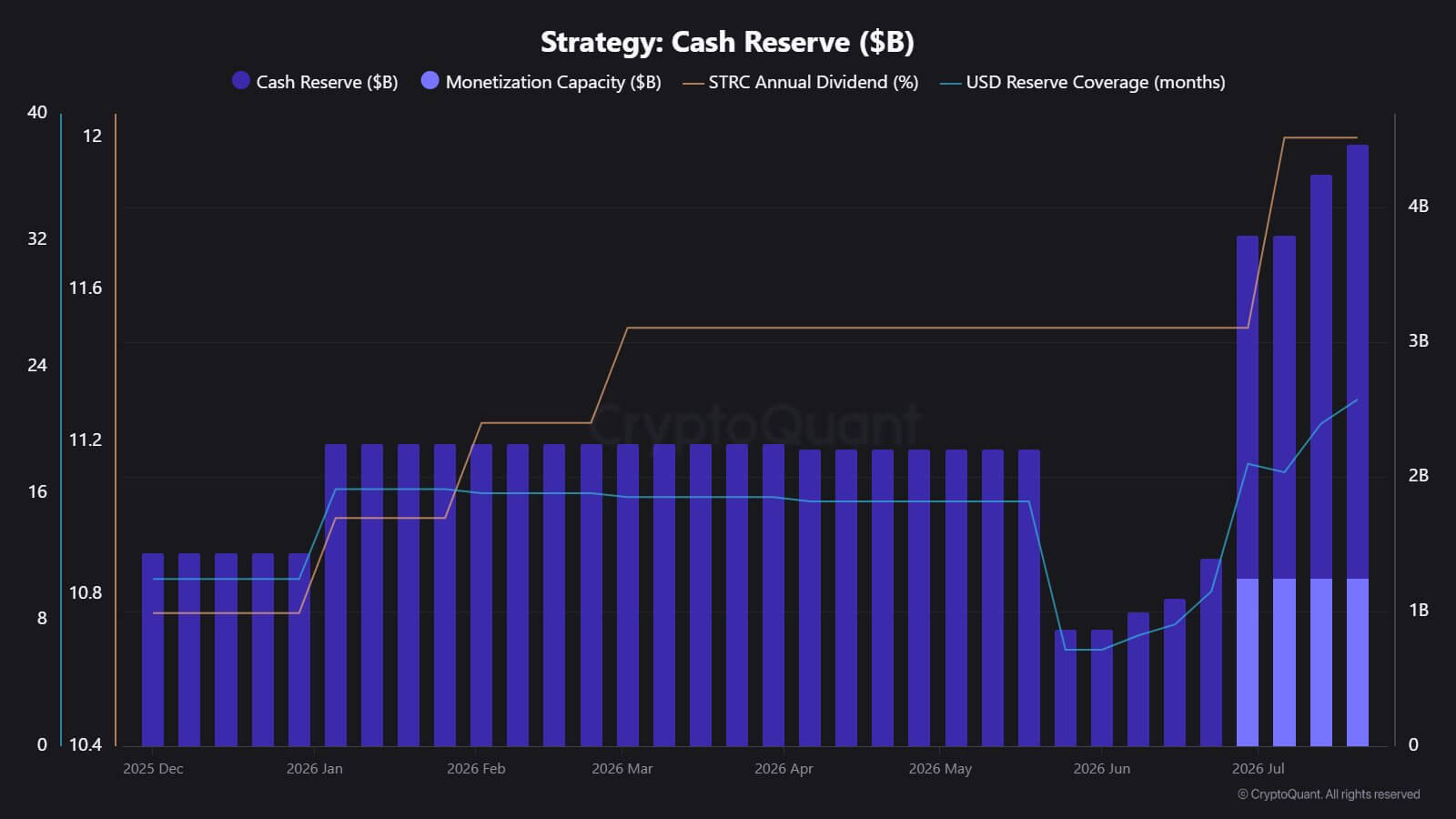
Part of that cash is intended to support Stretch, or STRC, the flagship security in Strategy’s expanding preferred-stock lineup.
STRC has a stated value of $100 per share and currently pays a variable annual dividend of 12%. It has traded below that level since mid-May, recently hovering near $87 after falling to about $75 in late June.
A larger reserve gives preferred holders greater assurance that Strategy can continue meeting its obligations during Bitcoin downturns or periods when weak security prices make additional issuance expensive.
Dylan LeClair, a Bitcoin strategy executive at Japanese treasury company Metaplanet, said Strategy’s recent common-stock sales and cash accumulation were aimed at restoring that funding channel.
A recovery in the preferred securities could narrow credit spreads and return them to prices at which management is willing to issue more shares, reviving the capital-markets engine Strategy has used to finance Bitcoin purchases, he said.
Strategy’s BTC buying pattern breaks
The effort to repair Strategy’s preferred-stock financing channel has interrupted the Bitcoin accumulation cycle that made it the world’s largest corporate holder of the asset.
Data from the company showed that it last bought Bitcoin on June 22, acquiring 520 BTC for about $35 million at an average price of $67,068. At the time, the purchase lifted its holdings to 847,363 BTC.
However, Strategy reversed course the following week, selling 3,588 BTC for about $216 million between June 29 and July 5. The transaction reduced its holdings to 843,775 BTC, where they have remained.
The remaining position was acquired for about $63.7 billion, or an average of roughly $75,476 per Bitcoin. At recent market prices, the holdings were worth about $54 billion, leaving Strategy with an unrealized loss of more than $9.4 billion.
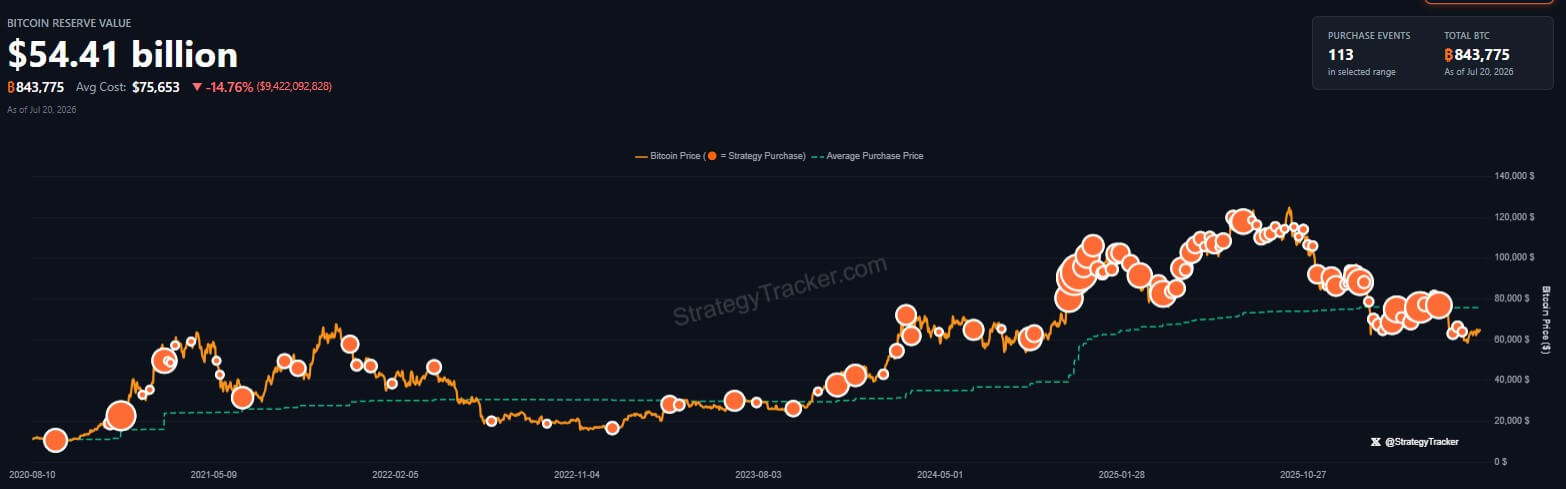
The company has now gone four weeks without a purchase, even as it continues to issue common shares and add to its dollar reserve. That marks an unusual break from a model in which proceeds raised from shareholders were often converted into Bitcoin soon after the financing closed.
Last week’s $263.5 million common-stock sale followed another issuance in the preceding reporting period that raised more than $460 million.
Together, the transactions increased Strategy’s share count while its Bitcoin holdings remained unchanged.
Strategy’s key Bitcoin metrics turn negative
That trade-off is now evident in the proprietary measures Strategy uses to assess whether its financing activity increases common shareholders’ Bitcoin exposure.
The company reported a quarter-to-date BTC Yield of -2.3% and a BTC Gain of -19,247 BTC. Its BTC-dollar gain for the quarter also fell to -$1.2 billion.
However, the corresponding year-to-date figures remained positive. Strategy reported a BTC Yield of 5.8%, a BTC Gain of 39,325 BTC, and a BTC dollar gain of roughly $2.5 billion, indicating that the deterioration has been concentrated in the current quarter.
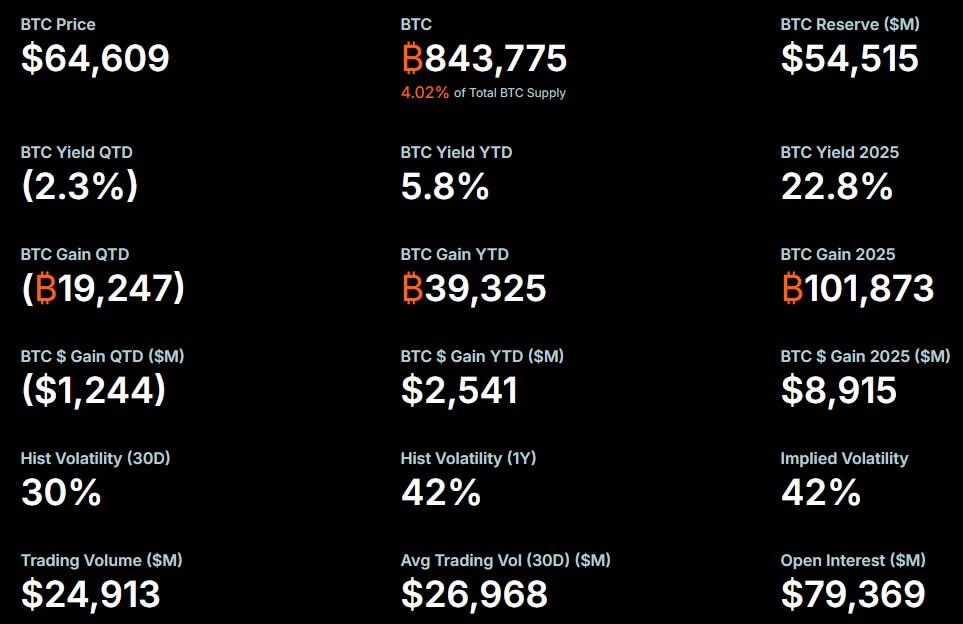
BTC Yield measures the percentage change in the ratio between Strategy’s Bitcoin holdings and its assumed diluted shares outstanding. BTC Gain applies that change to the company’s Bitcoin balance, while BTC dollar gain converts the result into dollars using the prevailing market price.
The indicators are not accounting profits or conventional investment returns. They are intended to show whether Strategy’s capital-markets activity has increased or reduced the amount of Bitcoin attributable to each diluted share.
The ratio weakened after Strategy issued more than 7.5 million common shares across the past two weeks without adding to its Bitcoin holdings. The share count increased while the company’s crypto balance remained fixed at 843,775 BTC.
Supporters of Strategy’s model argue that the decline in the official metrics overstates the economic effect because the calculations do not fully capture the value of the cash added to the balance sheet.
Strategy-focused analyst Adam Livingston estimated that last week’s issuance was nearly neutral for existing shareholders when measured under the Common Equity Bitcoin Exposure (CEBE) metric.
Counting only the $225 million added to the designated reserve, Livingston calculated that common-equity Bitcoin exposure declined by about 0.074%. That represented a loss of roughly 107 satoshis per existing share, equivalent to about $25.7 million across the previous share base.
However, the result changed when he included all $263.5 million of net proceeds. Under that calculation, the transaction was about 0.036% accretive, adding roughly 52 satoshis per existing share.
According to him, the difference stems from $38.5 million of proceeds that did not appear in the reported increase to the designated reserve. Strategy did not disclose whether the funds remained elsewhere as cash, reflected settlement timing, covered expenses, or were allocated to another balance-sheet category.
Livingston estimated that Strategy needed about $250.9 million in economic value from the issuance to leave common-equity Bitcoin exposure unchanged. The full proceeds exceeded that threshold, while the amount assigned to the reserve fell below it.
Thus, he argued that his calculation leaves the transaction close to neutral under either approach, rather than showing the substantial dilution suggested by the decline in gross Bitcoin per share.
Still, this does not alter the direction of Strategy’s reported metrics. BTC Yield and BTC Gain weakened because the company issued common stock without increasing its Bitcoin balance, even though the new cash improved its ability to meet preferred dividends and debt interest.
Strategy has therefore strengthened the protection around its capital structure while sacrificing near-term Bitcoin-per-share growth.
Whether the quarterly decline reverses will depend on how quickly the company can restore its preferred-stock financing channel and redirect new capital toward Bitcoin purchases.
The post Strategy’s Bitcoin metrics go negative amid $3.2B cash – sells 7.5M shares but buys 0 BTC for 4 weeks appeared first on CryptoSlate.



