




The XRP Ledger (XRPL) validated 3,254 transactions in ledger 106,965,249 on Sept. 13, giving the network a high-count mainnet result with a highly concentrated workload.
The ledger closed at 20:51:50 UTC, with 20 submitting accounts supplying 2,000 successful one-drop XRP payments, with each account submitting exactly 100 payments. The batch delivered 0.002 XRP.
Vet, an XRPL community figure posting as @Vet_X0, described the ledger as a new record and said the pattern probably reflected throughput testing.
The immediate result is that XRPL reached consensus on an unusually large set of included transactions. The composition of that set limits conclusions about sustained throughput, adoption, and XRP demand.
A closer look at the 3,254 transactions
The ledger recorded 2,295 successful results and 959 unsuccessful results. Its 2,000 one-drop payments made up most of the successful group, while several other transaction types added different forms of activity.
| Ledger measure | Observed result |
|---|---|
| Total included transactions | 3,254 |
| Successful results | 2,295 |
| Non-success results | 959 |
| One-drop payments from 20 accounts | 2,000 |
| OfferCreate transactions with non-success codes | 440 of 458 |
| XRP delivered by successful native-XRP Payments | 323.641509 XRP |
| XRP delivered by three CheckCash transactions | 1,950 XRP |
| Total across native delivered_amount entries | 2,273.641509 XRP |
| Transaction fees destroyed | 0.111136 XRP |
The complete transaction list contains 2,467 Payment transactions, 458 OfferCreate transactions, 229 TicketCreate transactions, 74 CheckCash transactions, 22 TrustSet transactions, three AccountSet transactions, and one NFTokenCancelOffer.
Successful native-XRP Payment transactions delivered 323.641509 XRP, while 3 successful CheckCash transactions delivered another 1,950 XRP, bringing the sum across native delivered_amount entries to 2,273.641509 XRP.
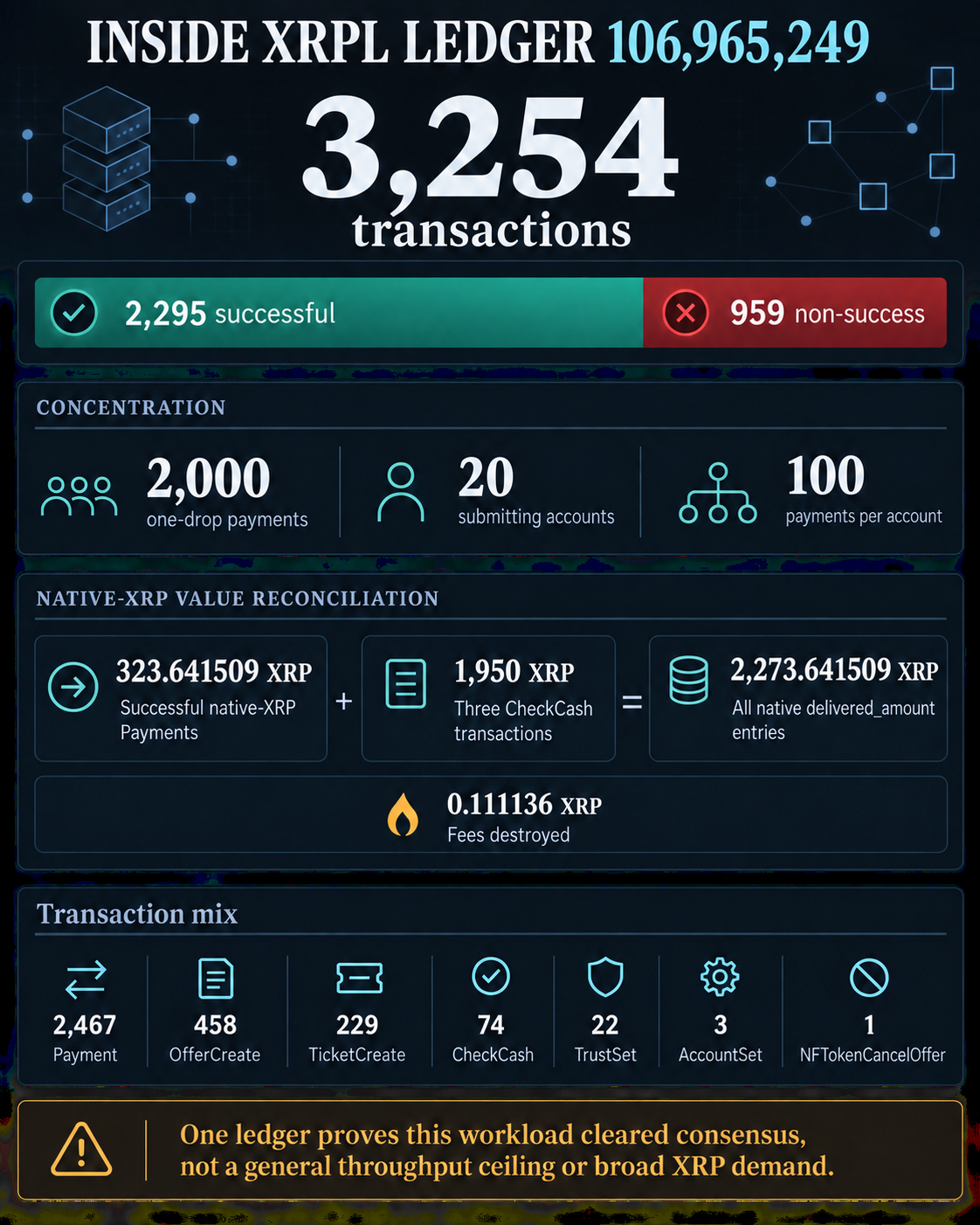
Both figures exclude issued-currency value and fall short of a total economic-volume measure because XRP and issued assets use different units, while order fields describe proposed exchanges rather than a single settled-value total.
Of 458 OfferCreate transactions, 440 returned non-success codes: 379 tecKILLED and 61 tecUNFUNDED_OFFER. Those 440 are a subset of the ledger’s 959 non-success results.
The ledger combined a large stream of successful micro-payments with unsuccessful activity and a smaller set of other operations. The 20-account pattern establishes concentration at the submitting-account level.
All Fee fields summed to 111,136 drops, equal to 0.111136 XRP, creating a second measurable connection to XRP. XRPL’s transaction-cost documentation explains that included transactions destroy their specified fees, including transactions that finish with certain failure codes.
The XRPL capacity signal and the demand question
The official Payment reference distinguishes direct transfers from cross-currency and path-based payments. Cross-currency transactions can traverse intermediary steps and consume decentralized exchange offers.
These mechanics make raw transaction counts an incomplete basis for comparing workloads.
Official documentation says the soft transaction limit rises when a ledger exceeds it and falls when consensus takes more than five seconds. The open-ledger cost can increase exponentially after that threshold. Ledger 106,965,249 shows that consensus included this particular transaction mix.
As of Sept. 15, XRP price registered an intraday high of $1.50, with $4.5 billion in 24-hour trading volume. Its Trading Activity indicator was 84 out of 100, and its Market Signal was Bullish at 65 out of 100.
For holders, the on-chain evidence supports delivered XRP and destroyed fees as measurable quantities. Durable token demand would require broader evidence, such as users acquiring and retaining XRP or economically significant activity consistently routing through the asset.
Recent reports pointed out to concentrated automated XRPL activity, stablecoin and DEX liquidity, and infrastructure for a future lending protocol.
Comparable scale from path payments, exchange activity, tokens, and future lending, paired with successful settlement and measurable value, would provide a more consequential capacity test.
The post XRPL proved it can handle over 3,000 transactions, but the traffic was entirely synthetic appeared first on CryptoSlate.



