





EU sanctions rules will bar direct and indirect transactions with HTX from Aug. 23 when those dealings fall within the bloc’s jurisdiction. For some individuals still needing to exit the exchange, an ordinary withdrawal will then require a narrow authorization from a national authority.
Council Regulation (EU) 2026/1848 lists “HTX (HUOBI GLOBAL SA)” in Annex XLV and sets Aug. 23, 2026, as the date the restriction applies. Article 5ad prohibits transactions with listed entities. Later amendments extend that prohibition to entities acting on behalf of or at the direction of a listed entity, as well as qualifying crypto-asset or payment service providers operating as mirror or successor entities.

The designation triggers a transaction ban. Any withdrawal, payment or other dealing caught by the rule must be completed before the application date or fit a specific exception or authorization.
Article 13 of Regulation 833/2014 applies the rules within EU territory and aboard aircraft or vessels under a member state’s jurisdiction. It also reaches member-state nationals anywhere, companies and other entities formed under member-state law wherever they operate, and any entity for business conducted wholly or partly in the Union.

An EEA or Swiss connection alone does not put a transaction under Article 13. That distinction matters because EEA and Swiss nationality or qualifying residence can make a person eligible for the separate exit provision without independently creating EU sanctions jurisdiction.
Who can withdraw after the cutoff
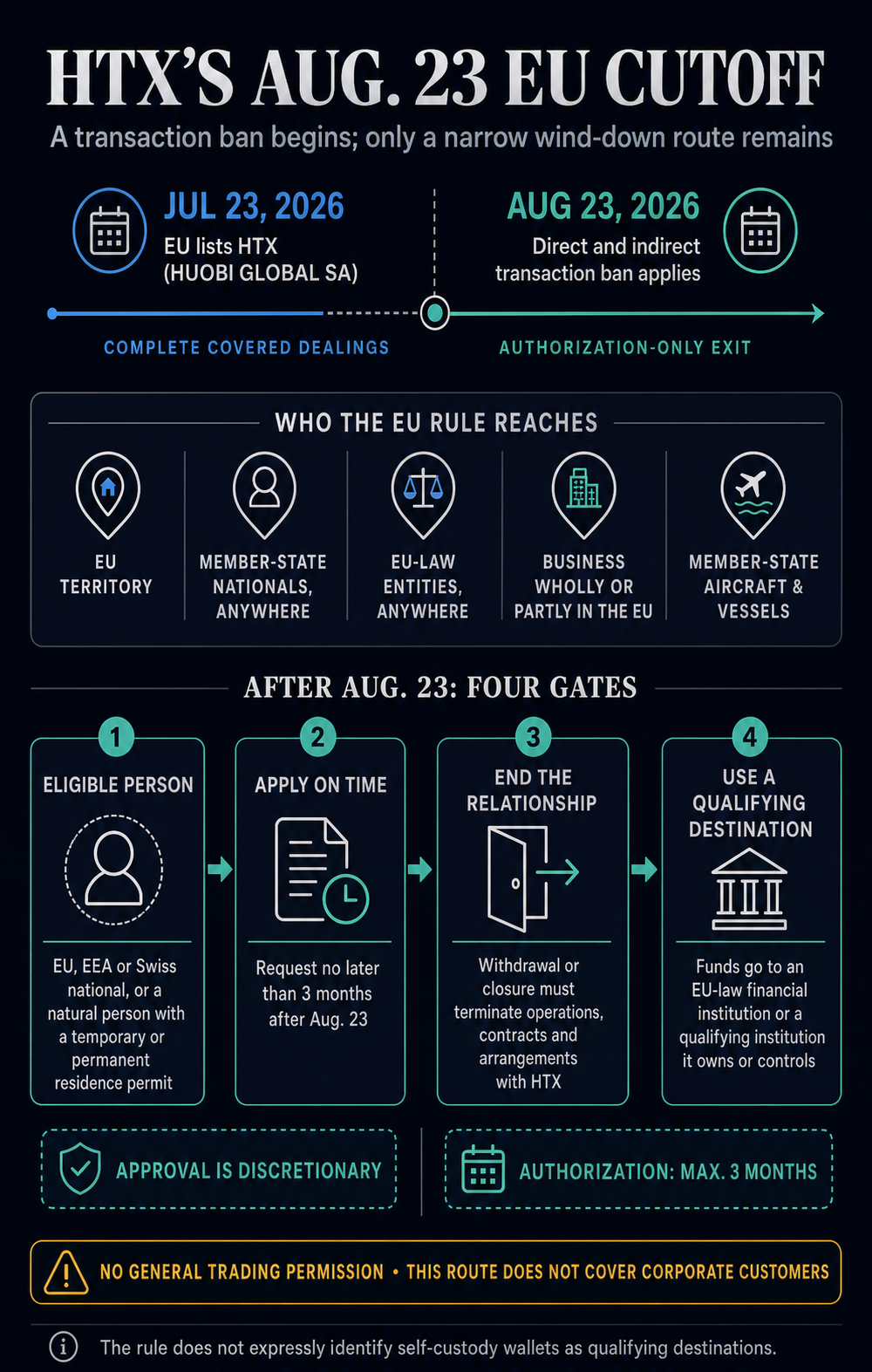
After Aug. 23, a member-state competent authority may authorize a transaction strictly necessary for an eligible person to withdraw funds or close an account with HTX. The person must terminate their operations, contracts and other agreements with the exchange. Approval is discretionary, may carry conditions and does not permit continued trading.
The route covers EU, EEA and Swiss nationals, plus natural persons holding a temporary or permanent residence permit in one of those jurisdictions. It does not extend this particular provision to corporate customers. A request must be filed no later than three months after the ban starts, while an authorization itself can remain valid for no more than three months.
Authorized funds must move to a credit or financial institution formed under an EU member state’s law, or to a third-country institution owned or controlled by one. The provision does not expressly identify a self-custody wallet as a qualifying destination.
HTX’s user agreement, dated June 18, already bars users in all EU member states from accessing its services. The restriction means the new rule should not be read as affecting a broad, established population of active EU residents. Potential exposure could include residual accounts, EU nationals abroad and covered counterparties, but no public figure in the available materials quantifies those groups.
In a May statement about a separate UK sanctions action, HTX said Huobi Global S.A. was distinct from the online exchange. The later EU regulation names “HTX (HUOBI GLOBAL SA)” together, so that earlier statement does not answer how HTX will handle the EU cutoff.

For transactions within the EU rule’s reach, Aug. 23 is the dividing line: complete the dealing beforehand or, if eligible, seek a discretionary authorization that ends the relationship rather than prolonging it.
The post Corporate crypto accounts on HTX face a complete dead end with zero legal exit routes when EU sanctions strike on August 23 appeared first on CryptoSlate.



