


There are 112 active wildfires in northwestern Ontario, according to the latest report issued Sunday night from Ontario’s Aviation, Forest Fire and Emergency Services (AFFES).
Of those, 12 are not under control, seven are being held, six are under control and the rest are being observed.
There were three new fires confirmed in the northwest region as of Sunday evening.
The forest fire hazard is mostly low and moderate across northwestern Ontario, with pockets of high hazard across southern parts of the region.
About 1,638 people from the region remain under evacuation due to wildfires as of Thursday, according to Jill Dunlop, the province’s minister of emergency preparedness and response.
In all, 14 communities have been evacuated and six have returned home.
“The number of evacuees is reported into the Provincial Emergency Operations Centre (PEOC) by community leadership. Evacuation numbers may fluctuate as community leadership confirm the total number of evacuated community members with the ministry,” wrote spokesperson Julia Facca on last Wednesday.
The ministry has held over 100 coordination calls with First Nation chiefs, leaders and communities, emergency management partners, municipalities and the federal government since the first Request for Assistance was received on July 14, according to Dunlop.
Evacuation orders or alerts remain in effect for areas near the following fires:
What to know about preparing go bags and emergency kits
Those under evacuation orders are required to leave the area, while those under evacuation alerts are urged to prepare to evacuate.
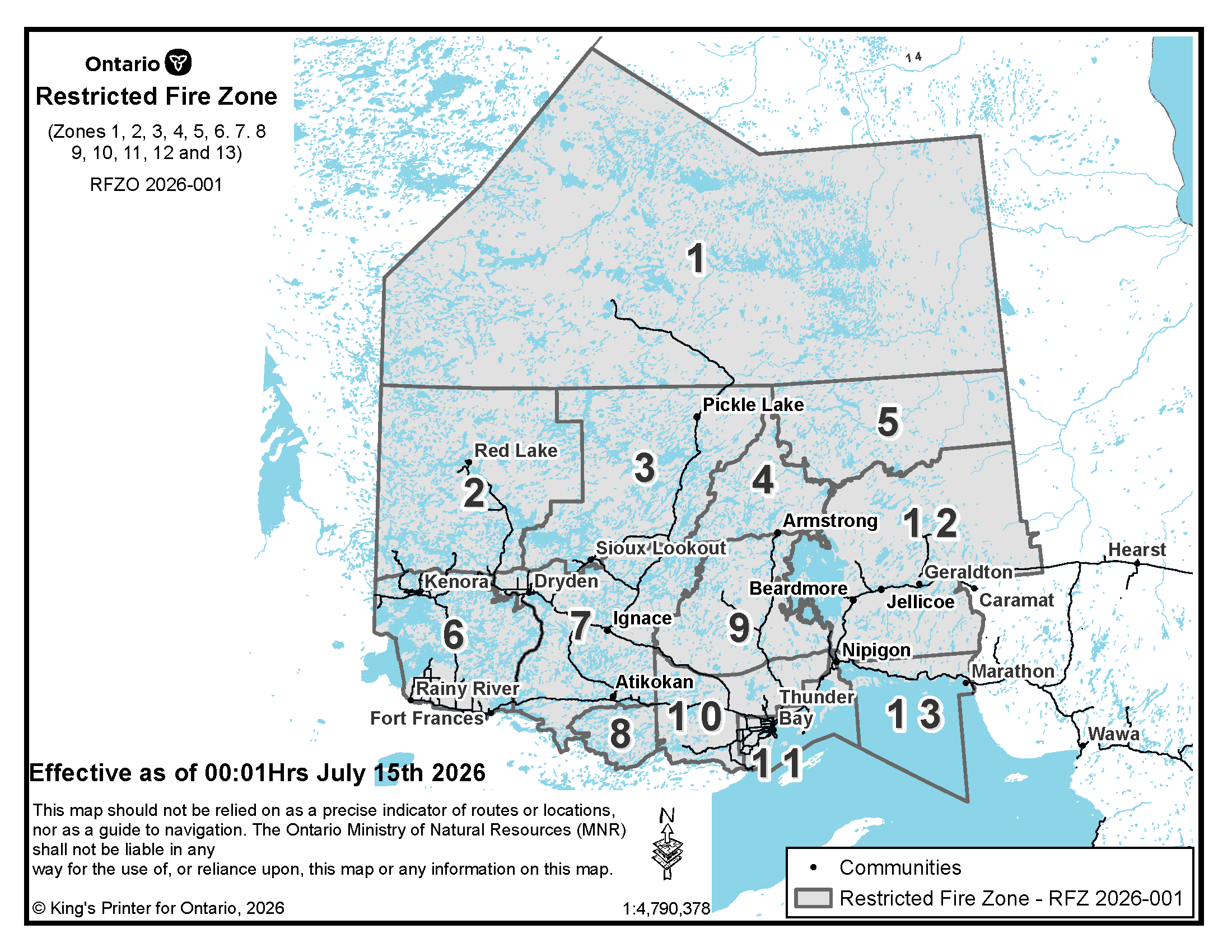
Northwestern Ontario and a small portion of northeastern Ontario remain under a restricted fire zone, which means no open-air burning, including campfires, is allowed.
Notice to Air Missions, or NOTAMs, have also been issued for Thunder Bay 36 and Fort Frances 14.
However, updates have been made to the implementation order currently in effect for active Thunder Bay 36, 56 and Dryden 34, 35 in the Thunder Bay–Ignace District on Friday, removing some areas previously included.
The Ministry of Natural Resources Thunder Bay-Ignace District also invoked an updated implementation order for areas near Fort Frances 14 as of Aug. 1, meaning travel is restricted in the specified area.
The evacuation alerts around active wildfire Fort Frances 13, known as the “Little Knife” fire in Minnesota, have been lifted.
The AFFES said suppression efforts are ongoing on Fort Frances 13, but there is no longer any concerns for public safety relating to the fires. Restrictions remain for other fires in the area.
According to the province’s interactive highway map, the following roads are closed due to wildfire activity:
The Ontario Provincial Police (OPP) urge people for their safety and the safety of emergency responders to:
Mail delivery has been suspended in the following communities due to wildfire activity:
Two new fires were confirmed in the northeast as of Sunday evening:
There are currently 44 active wildland fires in the northeast region. Of those, one is not under control, four are being held, one is under control and 38 are being observed.
Forest fire danger ratings are primarily low to moderate across northeastern Ontario, with high-hazard pockets near Timmins.
There are 100 contracted aircraft, including seven medium helicopters actively responding during wildfire season, according to the Ministry of Natural Resources.
It can also access up to 80 additional crews through private contracts if needed.
The ministry said it is providing an additional $650 million to purchase six new waterbombers and five new helicopters.
It has also added 170 new permanent fire personnel positions, including crew lead roles, and increased compensation for staff, including firefighters and pilots.
The ministry will conduct an after-action review of its wildfire response to inform improvements in planning and response.
More than 80 wildfires extinguished in Ontario in past 2 weeks: minister
There have also been four Ontario Corps partners and 17 Ontario Corps volunteers sent to help. The province said the following equipment/supplies have been provided:
Air purifiers, air scrubbers and replacement filters, in particular, were sent to five First Nations, allowing them to remain in their communities.
As part of these efforts, Feed Ontario and the Ontario Federation of Indigenous Friendship Centres are also shipping and distributing food to evacuees.
In addition, the Kaministiquia and Upsala fire departments were among some regional fire services to receive wildland fire skids from GlobalMedic.
Mexico, Alberta, New Brunswick, Newfoundland, the Yukon, PEI, the Canadian Forest Service and the Canadian Interagency Forest Fire Centre have also offered province-wide assistance.