





Bakkt, a digital-asset infrastructure company, reported $80.8 million of net income attributable to the company in its Q2 2026 results, reversing a $14.7 million loss a year earlier. But its Aug. 10 results show that investment marks, rather than an improvement in crypto-services operations, drove the profit.

The largest item was a $98.5 million non-cash gain from revaluing warrants in Transchem, an Indian listed company. A separate legacy warrant liability added another $1.4 million non-cash gain. Removing both marks from Bakkt’s $81.1 million pre-tax result before the equity-method loss produces an illustrative pre-tax loss of about $18.8 million. That is not a company-reported GAAP or non-GAAP subtotal, but it shows how strongly the headline result depended on fair-value accounting.
The Transchem gain reflects a recognized but unrealized increase in the fair value of a warrant asset that will be remeasured through earnings each period. A June 4 SEC filing shows that Bakkt paid $9.4 million, equal to 25% of the subscription price, for 47.5 million Transchem warrants after they were allotted in June.
The position was carried at $107.9 million on June 30, and Bakkt would owe about $28.2 million more if it fully exercises the warrants within 18 months. Bakkt cautioned that its aggregate Strategic Asset Value, which includes the Transchem position, does not represent market or liquidation value.
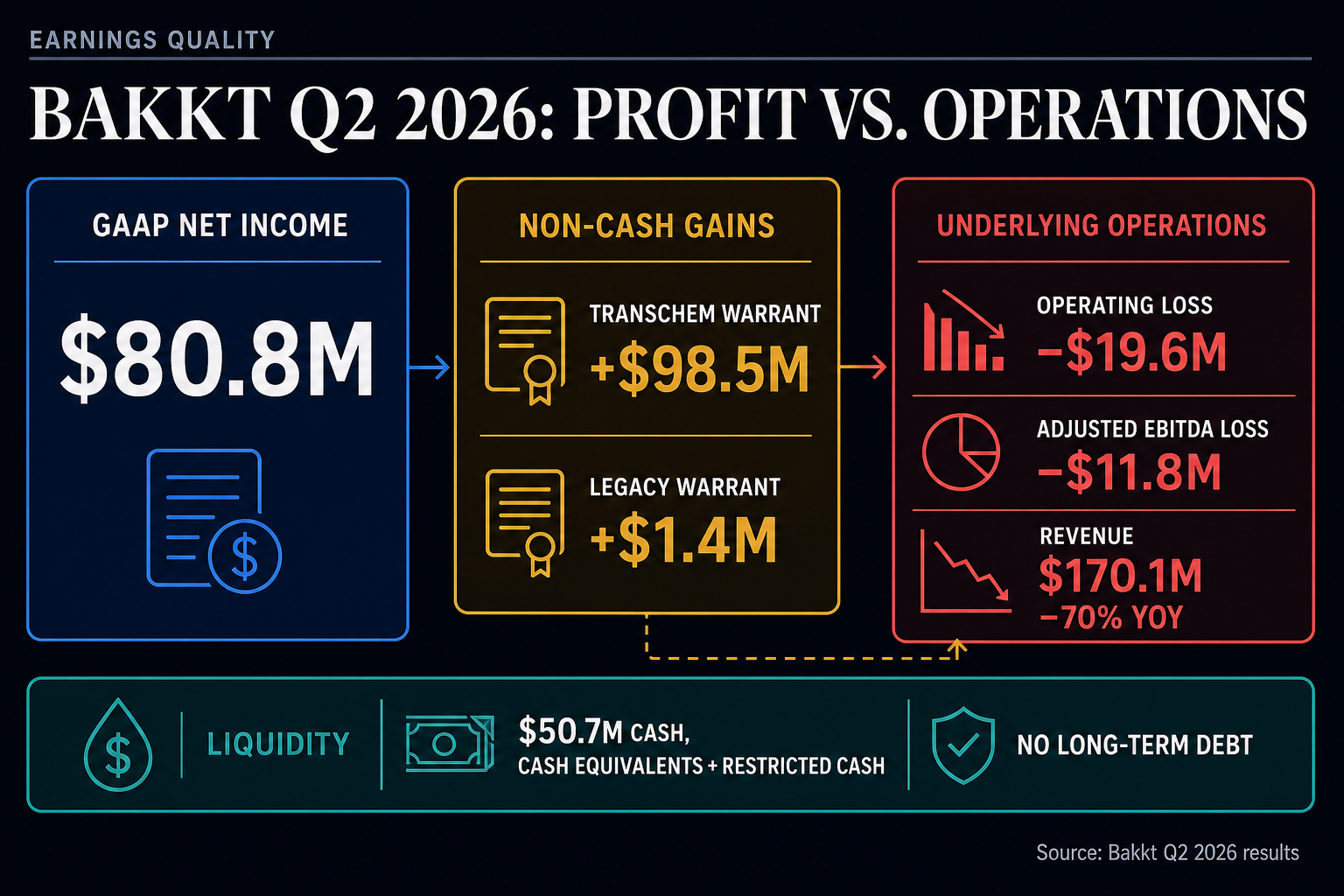

The operating picture moved the other way. Revenue fell 70% to $170.1 million from $568.1 million, which Bakkt attributed to client transitions and softer digital-asset trading volumes. Crypto costs and execution, clearing, and brokerage fees totaled $169.3 million, leaving a calculated residual of about $0.9 million before other operating expenses. Because Bakkt recognizes much of its crypto-services activity on a gross basis, the revenue figure is not equivalent to retained economics.
Its operating loss from continuing operations widened to $19.6 million from $16.1 million. Adjusted EBITDA, a non-GAAP measure, showed an $11.8 million loss compared with $9.8 million a year earlier. Management primarily attributed the change to weaker net crypto-services economics, higher salaries and contract labor, and a new equity-method loss, partly offset by lower selling, general and administrative costs.

Bakkt’s balance sheet tempers the downside. The company ended June with $50.7 million of cash, cash equivalents, and restricted cash and no long-term debt. Still, first-half operations used $26.9 million of cash, while financing activities supplied $67.2 million, driven chiefly by equity offerings. The quarter therefore delivered a GAAP profit and meaningful liquidity, but no evidence of an operating turnaround.
The post Crypto revenue tanks 70% for major AI finance company, but its paper gains just delivered a record quarterly profit appeared first on CryptoSlate.



