





Stablecoin issuers are emerging as a new source of demand for US government debt as foreign official holdings lose ground.
Tether and Circle have increased their Treasury securities and repurchase-agreement holdings by about $200 billion over the past five years, equivalent to more than 40% of the decline in China’s Treasury holdings over the same period, researchers at the Federal Reserve Bank of San Francisco said.
The shift is beginning to alter the investor base underpinning the world’s largest government bond market. Stablecoin issuers’ Treasury holdings have risen more than tenfold in five years as demand for dollar-linked digital tokens expanded, while China has continued a retreat from US debt that began more than a decade ago.
Stablecoins gain ground as foreign governments retreat
The rise of crypto-linked buyers comes as the composition of US creditors undergoes a longer-term change that could affect how cheaply Washington can finance its deficits.
Foreign investors held more than half of outstanding Treasury securities around 2008, but their share had dropped to roughly 30% by early 2026, the San Francisco Fed said. Within that group, foreign governments have declined even more sharply in relative importance, accounting for just above 40% of foreign Treasury demand by early 2026 compared with nearly all of it at their peak in the 1970s.
China has been central to that shift. Its Treasury holdings peaked in late 2013 and had fallen by more than half by mid-2026 as Beijing diversified its reserve assets.
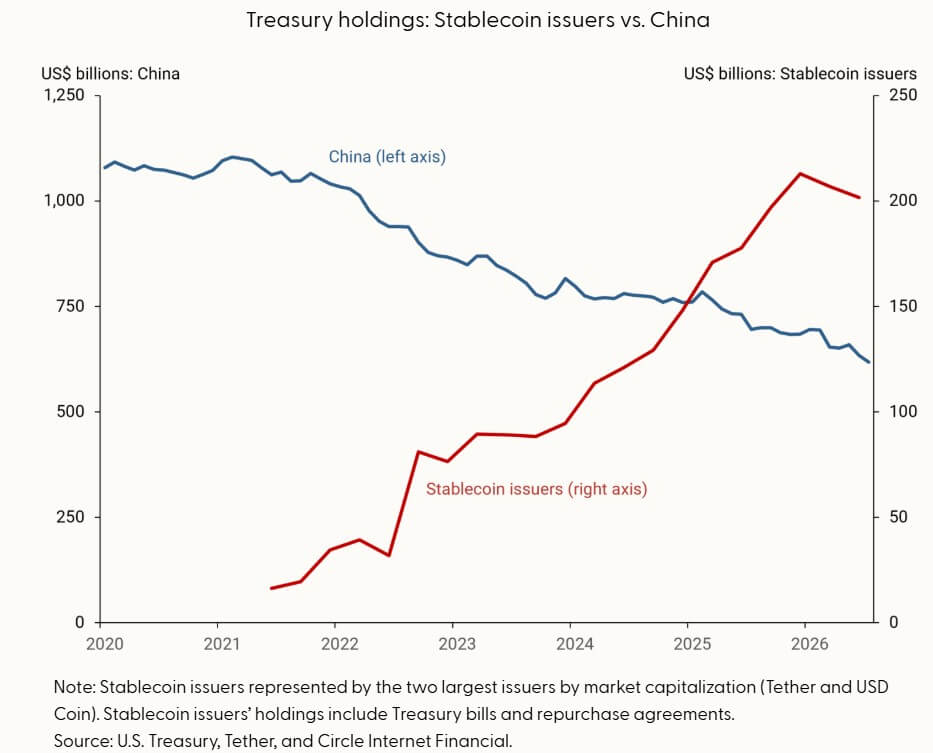
Private investors have taken a larger role as official foreign demand weakened, potentially making Treasury financing more sensitive to interest-rate changes and perceptions of US fiscal risk. Unlike central banks, which may hold Treasuries for reserve-management purposes, private investors can demand higher yields when risks rise or competing returns increase.
Stablecoin issuers add a different source of demand because their business model requires large pools of liquid dollar assets backing tokens that customers can redeem at par.
Tether’s USDT and Circle’s USDC accounted for more than 80% of stablecoin market capitalization as of mid-August, the Fed researchers said. Both issuers hold substantial amounts of short-term Treasury securities, along with cash, bank deposits, and repurchase agreements, to meet redemption demands.
Their growth has already made them significant participants at the short end of the Treasury market. Since 2023, stablecoin issuers have added more short-term Treasury holdings than Japan, the largest foreign holder of US government debt, according to the research.
That demand is also large enough to measurably affect short-term government bond yields, the San Francisco Fed said, citing research from the Bank for International Settlements.
The China comparison has a maturity gap
Stablecoins cannot fully replace the type of demand China has withdrawn because the two investor groups operate in different parts of the Treasury market.
China’s reductions have been concentrated largely in longer-dated US debt, while stablecoin issuers predominantly buy Treasury bills and other highly liquid, short-maturity assets. That means growing stablecoin reserves can deepen demand for bills without necessarily creating an equivalent buyer for longer-term notes and bonds.
The distinction comes as the US faces heavier financing requirements. Federal debt held by the public has risen from about 35% of gross domestic product in 2006 to roughly 100% today, increasing scrutiny of the investor base willing to absorb new issuance.
Regulation could reinforce stablecoins’ preference for the shortest maturities.
The GENIUS Act, adopted in 2025, created a federal framework requiring approved US payment stablecoin issuers to fully back outstanding tokens with eligible liquid reserves.
Proposed implementing rules include Treasury bills, notes and bonds with remaining maturities of 93 days or less, alongside cash, bank deposits and certain Treasury-backed repurchase agreements.
That structure effectively links growth in regulated dollar stablecoins with incremental demand for highly liquid US government securities.
For issuers, the economics can also be attractive. Customers hold tokens that generally do not pay them the yield earned on reserve assets, while issuers can collect interest from the Treasury securities backing those tokens.
As circulation expands, reserve portfolios and the associated interest income can rise with them.
Global stablecoin adoption could funnel more capital into T-bills
The next phase will depend on whether stablecoins continue attracting users outside the traditional crypto trading market.
The San Francisco Fed pointed to growing use of stablecoins for cross-border payments and as dollar-denominated stores of value in countries with volatile currencies. Usage relative to economic output is particularly high in Africa, the Middle East and Latin America, with much of the activity crossing national borders.
That creates a channel through which a stablecoin user abroad can indirectly finance US government borrowing. A customer acquiring dollar tokens creates additional reserve liabilities for the issuer, which can in turn purchase Treasury bills to back them.
Extending the industry’s recent growth rate would lift those holdings toward $400 billion by 2030, though the Fed researchers cautioned that the estimate carries substantial uncertainty. Regulation outside the US, competing digital-payment products and new bank technology could all slow stablecoin adoption.
Those competitive pressures will determine how much of the next wave of dollar-based payments ultimately flows through stablecoin issuers and into Treasury markets.
Banks developing cheaper cross-border settlement tools could capture some of that demand, while stablecoin companies expanding into remittances and payments would need to keep increasing liquid reserves as circulation grows.
The post Stablecoin issuers have replaced 40% of China’s lost US Treasury demand appeared first on CryptoSlate.


