Chainlink has taken another step toward institutional blockchain adoption after Moody’s Ratings successfully completed a pilot using its cross-chain technology. The development could strengthen Chainlink’s position in the growing tokenized asset market, raising questions about whether increasing institutional demand for blockchain infrastructure could eventually support LINK’s long-term value.
Announced on November 10, the collaboration demonstrated how Moody’s credit-rating information could be distributed simultaneously across multiple blockchain networks using Chainlink’s Cross-Chain Interoperability Protocol (CCIP).
Although the project remains in its testing phase, it represents another example of traditional financial institutions exploring blockchain infrastructure for real-world applications.
Moody’s And Chainlink Complete Multi-Chain Credit Ratings Pilot
According to the official announcement, the pilot connected Moody’s Ratings Token Integration Engine (TIE) with Chainlink’s CCIP technology.
The system successfully demonstrated how credit-rating information could move across permissioned and permissionless blockchain networks while maintaining Moody’s established publication and governance procedures.
Chainlink confirmed the development in a November 10 post on X, highlighting the potential role of its infrastructure in tokenized financial markets.
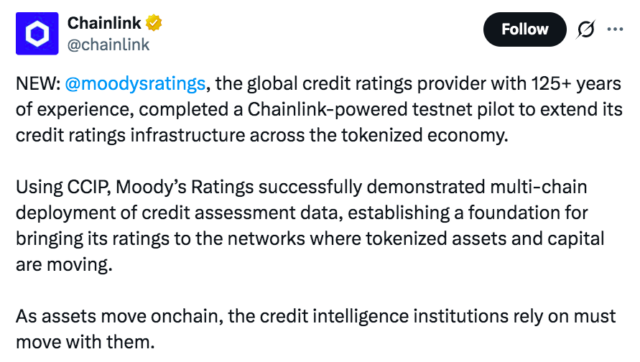
The experiment used representative test data rather than live financial ratings. No actual rating actions were published on-chain, and neither company announced a commercial deployment date.
Nevertheless, the results demonstrate how blockchain interoperability could eventually help financial institutions distribute important information without relying on separate systems for every network.
This is particularly relevant as tokenized bonds, investment funds, and other financial instruments continue expanding across blockchain ecosystems.
Chainlink Executive Explains Why Credit Data Matters
Johann Eid, Chief Business Officer at Chainlink Labs, emphasized that traditional financial information must evolve alongside tokenized assets.
“Credit ratings help institutions decide where to allocate capital and how they price risk,” Eid explained.
He added that credit intelligence must be able to move between blockchain networks as financial assets become increasingly tokenized.
The executive believes that Moody’s successful test provides an important foundation for institutional adoption.
Fabian Astic, Global Head of Digital Economy at Moody’s Ratings, shared a similar perspective.
“The future of tokenized finance is unlikely to reside on a single blockchain, platform, or market infrastructure,” Astic stated.
He explained that investors will increasingly expect access to credit information regardless of which blockchain supports their assets.
The comments highlight a growing challenge for traditional finance: blockchain networks are expanding, but institutional investors still require consistent access to reliable financial data.
As previously reported by Bitcoinist, Chainlink has already participated in Swift’s multi-bank tokenization trials, demonstrating how blockchain infrastructure can connect with existing financial systems.
Could Institutional Adoption Increase Demand For LINK?
For LINK investors, the most important question is whether institutional adoption of Chainlink technology will eventually translate into stronger demand for the cryptocurrency.
The latest Moody’s pilot strengthens Chainlink’s institutional adoption narrative, but it does not automatically create immediate buying pressure for LINK.
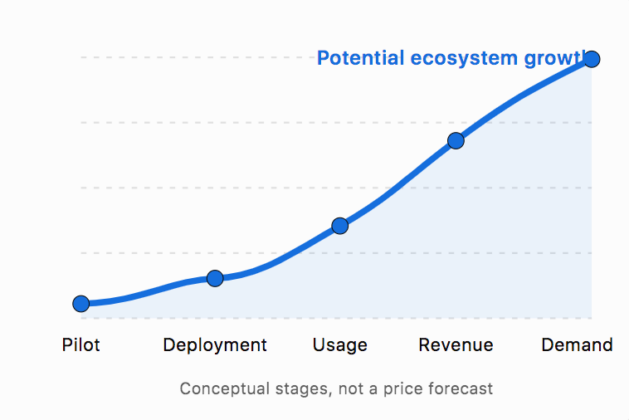
Illustrative pathway from institutional testing to commercial deployment, network usage, and possible LINK demand. These outcomes are not guaranteed.
Chainlink’s CCIP infrastructure enables communication and data transfers between different blockchain networks. As adoption expands, increased network activity and commercial usage could potentially contribute to the ecosystem’s economic activity.
However, the relationship between institutional partnerships and LINK’s market price depends on how services are monetized and whether revenue translates into token demand.
Bitcoinist previously examined this issue when Chainlink introduced changes to its BUILD program, moving toward commercial agreements that could connect infrastructure usage more closely with LINK-based economics.
The distinction matters because successful pilot programs do not necessarily generate immediate revenue or token purchases.
For a stronger bullish case, investors would want to see projects move beyond testing into production, accompanied by measurable usage, transaction activity, and commercial adoption.
LINK Price Outlook: What Should Investors Watch?
The announcement comes as LINK continues navigating broader cryptocurrency market volatility.
While institutional partnerships can strengthen long-term confidence, short-term price movements are still influenced by Bitcoin’s performance, market liquidity, and investor sentiment.
For LINK to establish a sustainable recovery, we would look for stronger trading volume, improving relative strength, and a successful breakout above nearby resistance levels.
An increase in spot demand alongside growing network activity would provide a more convincing signal than partnership announcements alone.
As Bitcoinist previously noted in its analysis of Chainlink’s CCIP adoption, the market increasingly wants evidence that institutional interest is translating into measurable network usage.
The Moody’s collaboration adds another important example to that discussion.
What Comes Next For Chainlink?
The successful pilot demonstrates that established financial institutions are exploring ways to bring traditional credit information into blockchain-based markets.
Moody’s has already rated or assessed more than 70 digital issuances between January 2017 and October 2026, including digital bonds and tokenized investment funds.
Its latest collaboration with Chainlink suggests that credit-rating infrastructure could become increasingly relevant as financial assets move across multiple blockchain networks.
However, the next important milestone will be a transition from controlled testing to live commercial implementation.
For now, the Moody’s pilot strengthens Chainlink’s position in institutional blockchain infrastructure.
If future deployments generate meaningful usage and commercial activity, they could support the longer-term investment case for LINK, even if the immediate price impact remains uncertain.