Ethereum co-founder Vitalik Buterin has thrown his support behind leanPCS, a cryptographic technique that could help the blockchain prepare for future quantum computing threats without significantly increasing transaction costs or on-chain data requirements.
Buterin’s change of position centers on EIP-8288, a draft proposal designed to combine large digital signatures and cryptographic proofs into a shared mathematical proof. Instead of requiring Ethereum to store every quantum-resistant signature individually, the approach would allow computers to aggregate verification data before transactions are added to the blockchain.
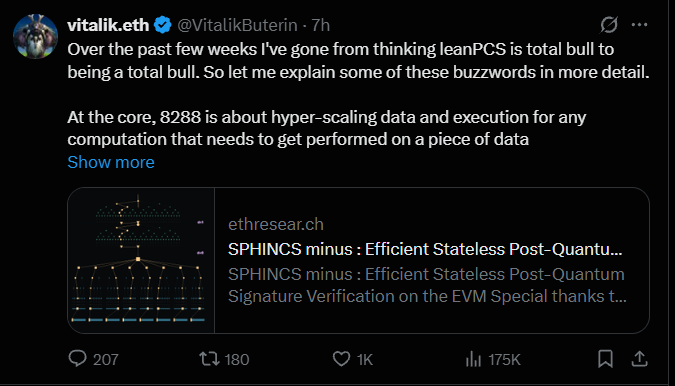
In a November 16 post on X, Buterin described his change of view, writing that he had gone from considering leanPCS “total bull” to becoming “a total bull” on the approach.
The proposal addresses one of Ethereum’s biggest potential challenges in preparing for quantum-resistant cryptography: the significantly larger size of the signatures and proofs that would replace today’s cryptographic standards.
Buterin Changes His Position on leanPCS as Ethereum Advances Quantum Defenses
Buterin’s endorsement reflects growing confidence in a method that could make Ethereum’s transition toward quantum resistance more practical.
Current Ethereum signatures typically occupy around 65 bytes. By comparison, some quantum-resistant alternatives could require between 1,000 and 6,000 bytes, according to Buterin. Certain cryptographic proofs used by privacy applications could also expand from a few hundred bytes to approximately 128 kilobytes.
Storing this additional information directly on Ethereum would consume considerably more block space. That could increase the cost of transactions and make it more expensive for users to interact with decentralized applications.
The approach relies on polynomial commitment schemes, mathematical tools used in cryptographic proof systems. By standardizing a shared verification component, different proof systems could use the same underlying mechanism without requiring developers to adopt an identical architecture.
Buterin believes this could provide Ethereum with a faster route toward supporting quantum-resistant accounts and more advanced cryptographic applications.
EIP-8288 Could Combine Thousands of Signatures Into One Proof
Under the design, users would continue submitting signatures or cryptographic proofs to demonstrate that transactions and other operations are valid. However, rather than storing every large signature individually, network participants could combine multiple verification results into aggregated proofs.
Ethereum would only need to retain the transaction instructions and sufficient information to verify the aggregated result. The full collection of bulky signatures and proofs would not need to be permanently stored on-chain.
The benefits could also extend beyond wallet security. Privacy applications that rely on zero-knowledge proofs could use the same approach to demonstrate that transactions follow the required rules without revealing sensitive information.
By reducing the amount of data that needs to be recorded individually, proof aggregation could make more advanced cryptographic features practical without placing the entire storage burden on Ethereum users.
Three Approaches Considered for Ethereum’s Quantum-Safe Transition
EIP-8288 outlines three possible approaches to handling the larger signatures and proofs required by quantum-resistant systems.
The first, leanSPHINCS, is the most specialized option. It would support a particular family of hash-based quantum-resistant signatures, offering a relatively straightforward path toward protecting Ethereum accounts. However, its functionality would be limited to that signature system.
At the other end of the spectrum is leanSTARK, a more general approach that could support different signature schemes, privacy applications, and more complex verification processes. Its implementation would require Ethereum developers to agree on a new programming language for the programs being verified.
That decision could represent a substantial architectural change for Ethereum, potentially extending beyond its existing Ethereum Virtual Machine (EVM) framework.
This is the approach Buterin now favors, arguing that it could be introduced considerably sooner. The broader leanSTARK framework could potentially follow later, allowing Ethereum to expand its cryptographic capabilities over time.
Buterin described the opportunity as a route toward a “cryptographic proof singularity” much sooner than developers had previously expected.
Ethereum’s Quantum-Security Roadmap Gains Momentum
Buterin’s latest endorsement comes as Ethereum developers increasingly prioritize protection against potential quantum computing threats.
The Ethereum Foundation established a dedicated post-quantum research team earlier in 2026, while developers have been exploring changes to account authentication, validator keys, and privacy-related cryptography.
EIP-8288 could become an important component of this broader effort by addressing the additional data and verification costs associated with quantum-resistant systems.
However, the proposal remains a draft, and its reference implementation is unfinished. Buterin’s support does not mean that leanPCS has been approved for deployment or assigned a mainnet activation date.
If the approach proves practical, it could help the network adopt stronger cryptographic protections while limiting the impact on transaction fees and blockchain storage requirements.
Do you think leanPCS could significantly accelerate Ethereum’s transition toward quantum-resistant security?