The World Bank Group is taking another significant step toward blockchain-based finance, announcing a new collaboration with banking giant Citi and stablecoin issuer Circle to explore how USDC could transform international development payments.
The initiative comes as Ethereum attracts growing Wall Street interest, with major financial institutions increasingly examining blockchain technology for settlement, tokenization, and cross-border transactions.
Announced on November 17, the World Bank’s latest initiative will investigate whether regulated, dollar-backed stablecoins can reduce transaction costs, accelerate payments, and improve transparency when development funds are distributed internationally.
Although the project remains exploratory, the involvement of one of the world’s largest development institutions could represent an important milestone for stablecoin adoption.
World Bank Explores USDC Payments With Citi And Circle
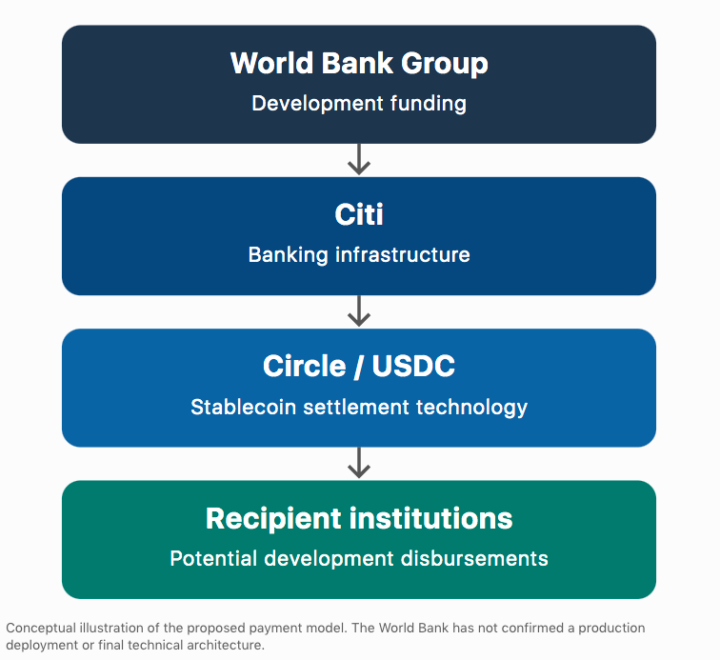
According to the official World Bank announcement, the institution will work with Citi and Circle to examine how blockchain-based payment infrastructure could complement its existing international banking arrangements.
Under the proposed model, Citi would provide access to established banking networks, while Circle would contribute the technology required to issue and settle payments using USDC.
The objective is not to eliminate traditional banks, but to explore whether stablecoins can make existing payment systems more efficient.
Currently, international development payments often move through correspondent banking networks involving multiple financial institutions. These arrangements can introduce delays, additional costs, and operational complexity.
Blockchain-based settlement could potentially simplify parts of this process by allowing funds to move across participating networks with greater visibility.
World Bank President Ajay Banga emphasized that improving payment efficiency could have practical consequences for development projects.
Faster transfers could help ensure that essential funding reaches communities when it is needed, rather than being delayed by traditional settlement processes.
Importantly, the announcement does not confirm that the World Bank has begun distributing development funds through USDC. No specific launch date, payment volume, or participating blockchain has been disclosed.
Circle CEO Calls World Bank Initiative A Major Step Forward
Circle CEO Jeremy Allaire welcomed the announcement, highlighting its potential to make global financial infrastructure more accessible.
In a November 17 post on X, Allaire described the collaboration as an important development for the future of international payments.
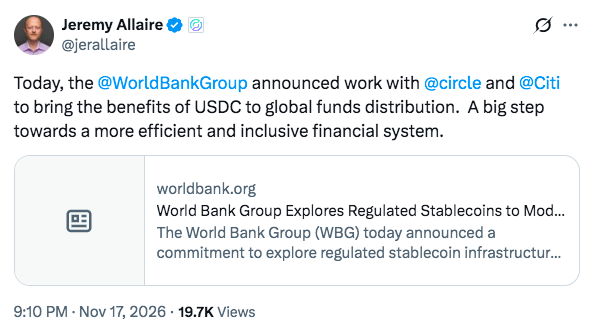
Allaire’s comments reflect a broader industry argument that blockchain-based dollars could become increasingly useful outside cryptocurrency trading.
For Circle, the World Bank initiative could also strengthen USDC’s position as financial institutions evaluate regulated stablecoins for real-world applications.
Rather than focusing exclusively on trading activity, USDC could potentially support institutional payments, treasury management, and international fund distribution.
The collaboration also builds on the World Bank’s existing blockchain experience.
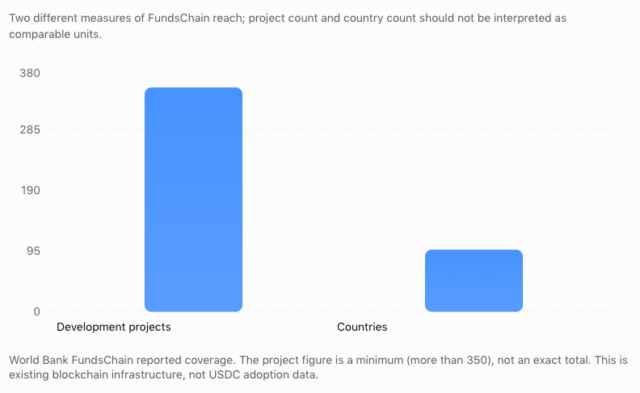
Its FundsChain platform currently supports the tracking of funds associated with more than 350 development projects across 96 countries.
This infrastructure already allows participating organizations to monitor how project funds are used, demonstrating that blockchain technology has applications beyond cryptocurrency markets.
Could Ethereum Benefit From The World Bank’s Crypto Expansion?
The World Bank’s latest initiative could have implications for the broader blockchain industry, particularly networks that support stablecoin transactions.
Ethereum remains an important part of this ecosystem, supporting USDC transfers, decentralized financial applications, and tokenized assets.
As Bitcoinist previously reported, institutional and business-related transactions account for a substantial portion of Ethereum’s stablecoin transfer volume.
This suggests that blockchain-based dollars are increasingly being used for financial activity beyond individual cryptocurrency transfers.
The World Bank’s exploration could reinforce this trend by encouraging additional institutions to consider blockchain settlement infrastructure.
However, the announcement does not identify Ethereum as the network selected for the proposed payment model.
USDC operates across multiple blockchains, meaning Ethereum, Solana, and other compatible networks could potentially compete for future institutional payment activity.
The implications for ETH would therefore depend on whether Ethereum is eventually selected and whether the initiative generates sustained network usage.
Nevertheless, the development strengthens the broader argument that programmable blockchain infrastructure could play an increasingly important role in global finance.
Traditional Banks Are Moving Closer To Blockchain Payments
The collaboration also reflects a wider transformation taking place across traditional banking.
Financial institutions are increasingly exploring ways to combine established regulatory and payment infrastructure with blockchain settlement capabilities.
As Bitcoinist recently highlighted, PNC Bank has introduced USDC payment capabilities for eligible corporate clients using Ethereum infrastructure.
The development demonstrates how banks are beginning to incorporate stablecoins into services designed for businesses and institutional customers.
Citi’s participation in the World Bank initiative represents another example of this growing interest.
The bank operates across more than 180 jurisdictions, giving it extensive experience managing international payment networks.
Connecting that infrastructure with Circle’s stablecoin technology could provide an opportunity to examine how conventional banking and blockchain settlement might work together.
However, several challenges remain, including regulatory compliance, currency conversion, liquidity management, and the practical costs of moving funds between traditional accounts and blockchain networks.
These considerations will help determine whether stablecoins can deliver meaningful advantages over existing payment systems.
What Happens Next For USDC And Institutional Crypto Adoption?
The World Bank’s announcement represents an encouraging development for the cryptocurrency industry’s long-term integration with traditional finance.
Rather than treating blockchain exclusively as a speculative technology, major financial institutions are increasingly examining its potential to solve operational problems.
The initial exploration will focus on payment models involving intermediary financial institutions and borrower countries where digital asset activity is legally permitted.
Additional banking partners could eventually become involved as the initiative develops.
We believe the most important question is whether this collaboration can demonstrate measurable improvements in settlement speed, costs, and transparency.
If successful, the approach could encourage other international organizations and financial institutions to investigate similar infrastructure.
For now, the World Bank’s decision to explore USDC alongside Citi and Circle offers another indication that stablecoins are moving closer to mainstream financial applications.
The next milestones will be the announcement of participating countries, specific payment arrangements, and any confirmed implementation timeline.