



The crypto market faces a pivotal regulatory moment as the US Senate Banking Committee prepares to vote on the CLARITY Act on Thursday, May 14 — a markup session that will determine whether the most comprehensive digital asset framework in American history advances or returns to the negotiating table. The timing arrives against a backdrop of genuine momentum in on-chain activity that makes the legislation’s specific provisions more consequential than they would have been at any earlier point in the cycle.
XWIN Research Japan has drawn attention to a CryptoQuant dataset that contextualizes exactly what is at stake. The All Stablecoins ERC-20 Active Addresses chart shows a sharp rise in stablecoin usage since late 2025, with active addresses briefly approaching 600,000 in 2026 — a level that reflects not simply more stablecoin supply circulating, but genuine growth in real on-chain dollar usage. People are using stablecoins as a functional payment and settlement layer at a scale the network has not previously seen.

Into that growing ecosystem, the CLARITY Act introduces a regulatory distinction with significant structural implications. The bill’s current draft draws a clear legal line between payment stablecoins — which it appears designed to protect and legitimize — and yield-bearing stablecoin products, which face considerably more restrictive treatment.
Building on the already-passed GENIUS framework that prohibits issuers from paying interest simply for holding stablecoins, the CLARITY draft extends those restrictions to exchanges, custodians, brokers, and wallet providers — targeting the deposit-like APY model that has attracted millions of users to products promising 3% to 5% simply for holding USDC.
The CLARITY Act Is A Boundary. And The Boundary May Actually Help
The XWIN Research Japan analysis draws the distinction that prevents the CLARITY Act from being misread as a broad regulatory assault on the stablecoin ecosystem. The bill does not ban stablecoins. It does not target DeFi as a category. What it appears designed to do is considerably more precise: formalize stablecoins as regulated payment infrastructure while drawing a legal boundary between that infrastructure and the bank deposit model that yield-bearing products have been approximating.
The boundary is not absolute. Rewards tied to genuine economic activity — liquidity provision, staking, governance participation, and collateralized lending — may remain permissible under certain conditions. The distinction the CLARITY Act draws is between passive yield for simply holding a stablecoin and yield generated through actual participation in financial activity. The former is the target. The latter appears to have a viable path forward.
Related Reading: Top Investor Breaks Down The CLARITY Act: Bitcoin Gets Legal Clarity, Stablecoins Get Restricted
The structural focus of the legislation falls on centralized intermediaries — exchanges, custodians, brokers, and wallet providers offering bank-like APY products. Genuinely decentralized protocols and self-custody activity are not identified as the primary regulatory concern.
The forward implication the analysis identifies is constructive and extends beyond stablecoins. Regulatory clarity around payment infrastructure tends to accelerate adjacent development — tokenized US Treasuries, real-world asset products, and on-chain financial infrastructure all benefit from a defined legal environment. And since stablecoins function as the core dollar liquidity layer of crypto markets, expanding regulated stablecoin usage creates the capital flow conditions that historically strengthen long-term inflows into Bitcoin as well.
Thursday’s vote will determine whether that framework becomes law or returns for further negotiation. The on-chain usage data suggests the market has already been moving in the direction the legislation is trying to formalize.
Stablecoin Dominance Declines As Capital Gradually Returns To Risk Assets
Stablecoin dominance is trading near 12.1% after declining steadily from the February peak above 14%, a move that reflects capital gradually rotating back into higher-risk crypto assets following the first quarter correction. The chart shows that stablecoin dominance accelerated sharply during the February selloff as investors moved aggressively into dollar-pegged assets for protection while Bitcoin and altcoins experienced heavy liquidation pressure across the market.
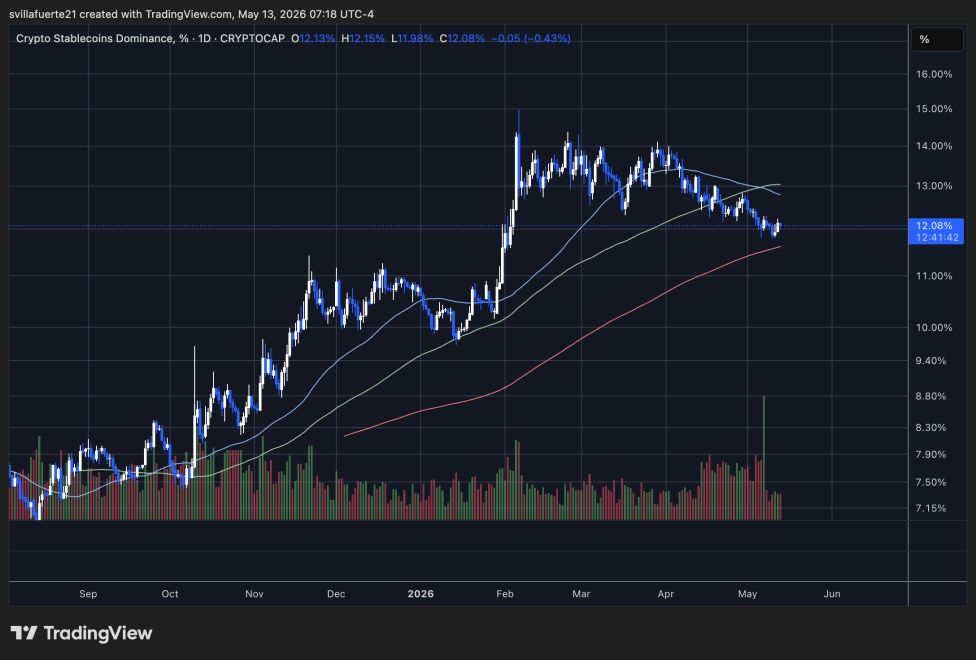
That spike above 14% marked one of the highest stablecoin dominance readings of the cycle and coincided closely with the period of maximum fear and forced selling. Historically, rising stablecoin dominance tends to reflect defensive positioning, as traders reduce exposure to volatile assets and hold liquidity in stablecoins while waiting for clearer market conditions.
Since March, however, the structure has started to reverse. Stablecoin dominance has fallen back below the 50-day moving average and is now testing the 100-day moving average near the 12% region. That decline suggests part of the sidelined capital that accumulated during the correction is gradually re-entering the market.
At the same time, dominance remains well above the levels seen during peak speculative phases in previous bull cycles. This indicates that a large amount of liquidity still remains parked in stablecoins rather than aggressively chasing risk.
Featured image from ChatGPT, chart from TradingView.com